Scattering of Strong Radio Waves by Particles in Strongly Magnetized Plasmas and Implications for Fast Radio Bursts

Scattering of Strong Radio Waves by Particles in Strongly Magnetized Plasmas and Implications for Fast Radio Bursts
Yuanhong Qu, Pawan Kumar
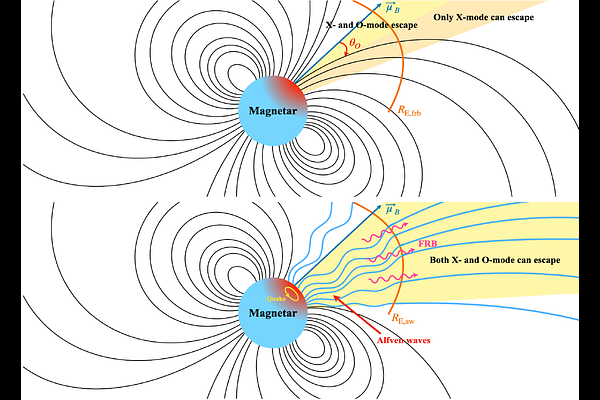
AbstractFast Radio Bursts (FRBs) are millisecond-duration radio transients that are widely believed to originate within magnetar magnetospheres. Large-amplitude radio waves associated with FRBs propagate through strongly magnetized plasmas, where nonlinear scattering can affect their propagation. By solving the relativistic motion of a single particle interacting with electromagnetic waves of arbitrary polarization and propagation angle $θ_B$, we compute the scattering cross section and the corresponding optical depth. The scattering cross section of the O-mode can exceed that of the X-mode when $a\sinθ_B < ω_B/ω$, and becomes comparable to that of the X-mode when $a\sinθ_B > ω_B/ω$, where $θ_B$ is the angle between the wave vector and the background field. In the strongly magnetized and quasi-parallel limits, the cross sections asymptotically recover the linear regime scalings and are strongly suppressed by relativistic particle motion, leading to optical depths well below unity. We also show that curvature radiation losses of O-mode waves are strongly suppressed for quasi-parallel propagation, allowing them to escape from the magnetosphere at moderate multiplicities. We propose that Alfvén waves excited by magnetar crust quakes can reach amplitudes comparable to the background magnetic field, thus straightening field lines and reducing $θ_B$. This geometrical alignment enhances the ability of FRBs to freely propagate through the open field line region. These results suggest that large-amplitude waves propagating quasi-parallel to open magnetic field lines can avoid significant single-particle scattering losses, providing a possible condition for their escape.