Asteroseismic Analysis of the Merger Product Red Giant in the $γ$ Persei System

Asteroseismic Analysis of the Merger Product Red Giant in the $γ$ Persei System
Rozália Z. Ádám, László Molnár, Róbert Szabó, Csilla Kalup, Frank Grundahl, Daniel Huber, Mads Skakke Fredslund, Pere L. Pallé, Dóra Tarczay-Nehéz, Jonatan Rudrasingam
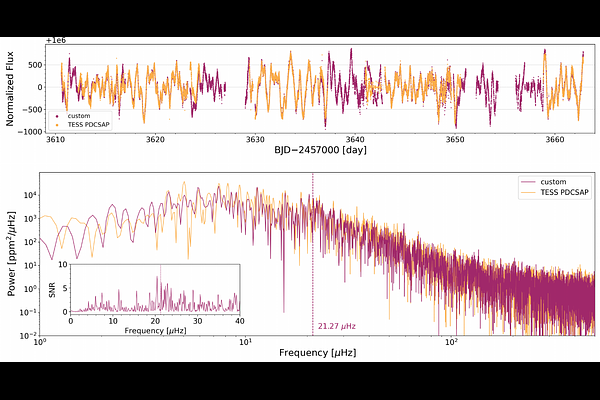
AbstractContext. $γ$ Persei is a long-period eclipsing binary system ($P\approx 14.6$ years) containing a red giant primary, and it is well known for its multi-faceted classification as a visual and spectroscopic binary. Its brightness and binary nature together make it a valuable target for both photometric and spectroscopic studies, particularly in the context of asteroseismology and stellar evolution, as the primary star likely formed through a stellar merger. Aims. We aim to determine the seismic parameters $ν_{\rm max}$, $Δν$, and the oscillation amplitudes of the primary component, an evolved giant, to estimate its seismic mass $-$ which we can compare to its estimated dynamic mass. Methods. We use Transiting Exoplanet Survey Satellite (TESS) data obtained during Sectors 58, 85, and 86 and to complement the space-based observations, we incorporate high-resolution RV measurements acquired by the Stellar Observations Network Group (SONG) during two distinct epochs; 2017 and 2024. Results. We successfully detect solar-like oscillations in $γ$ Per and infer a seismic mass of $3.25\pm0.13$ M$_\odot$, which is slightly below the dynamical mass. We find the photometric oscillation amplitudes to be significantly lower than predicted from scaling relations, but in line with other high-mass red giants. We also find that radial velocity amplitudes along the Hertzsprung-Russell diagram cannot be fitted uniformly with current scaling relations.