Sleeping or Dead? Probing the Quenching Mechanism of JWST Dormant Galaxies at z > 3 with ALMA

Sleeping or Dead? Probing the Quenching Mechanism of JWST Dormant Galaxies at z > 3 with ALMA
Mengyuan Xiao, Songnan Qi, Pascal A. Oesch, Longji Bing, Miroslava Dessauges-Zavadsky, Andreas L. Faisst, Mahsa Sanati, Rashmi Gottumukkala, Gabriel Brammer, David Elbaz, Robert Feldmann, Yoshinobu Fudamoto, Lucas C. Kimmig, Benjamin Magnelli, Rui Marques-Chaves, Anurag Amol Sawarkar, Sune Toft, Francesco Valentino, Christina C. Williams
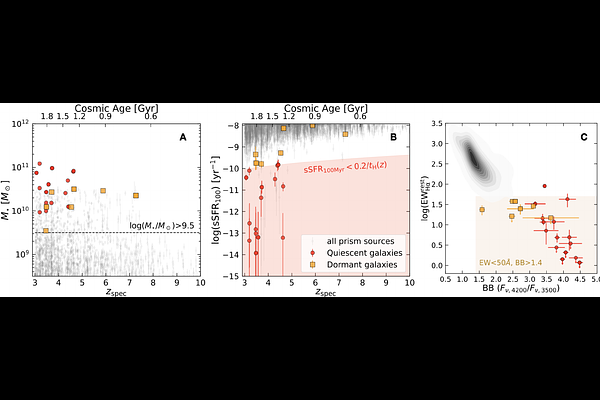
AbstractJWST has revealed a population of "dormant'' galaxies at z>3 with strong Balmer breaks and weak emission lines, whose star formation appears to have declined only recently. Whether these galaxies are undergoing a lasting transition toward quiescence or merely experiencing a temporary suppression of star formation remains unclear. We investigate their molecular gas content using archival ALMA observations of [CII]158um and CO rotational transitions. Starting from all publicly available JWST/NIRSpec prism observations and using joint spectrophotometric fitting, we construct a parent sample at z>3 and log(Mstar/Msun)>9.5 in the ALMA-accessible COSMOS, UDS, and GOODS-South fields. Our final sample comprises 7 dormant galaxies and 15 quiescent galaxies with ALMA constraints on their molecular gas content (mostly 3 sigma upper limits). We find that dormant galaxies exhibit systematically lower star formation rates averaged over the past 10Myr (SFR10Myr) than over the past 100Myr (SFR100Myr), supporting a recent rapid decline in their star formation. For the ~70% of the sample with sufficiently constraining ALMA observations, their molecular gas fractions lie at least ~0.3-2dex below those expected for main-sequence galaxies. Moreover, the molecular gas fractions of dormant galaxies show no systematic difference from those of quiescent galaxies in our sample. This indicates that dormant galaxies have already reached a gas-poor state shortly after quenching and favors a scenario in which the rapid shutdown of star formation is associated with depletion or removal of the molecular gas reservoir, rather than primarily with suppressed star formation efficiency while retaining a substantial molecular gas reservoir. Our results suggest that, if no substantial gas replenishment occurs in the future, dormant galaxies are more consistent with becoming "dead'' than with being temporarily "sleeping''.