UGC 2369S: a Kpc Scale Triple Merger Candidate Identified in a Nearby Luminous Infrared Galaxy

UGC 2369S: a Kpc Scale Triple Merger Candidate Identified in a Nearby Luminous Infrared Galaxy
Yuanze Ding, Michael J. Koss, Fiona A. Harrison, Charles C. Steidel, Connor Auge, Jared Gillette, Erica Hammerstein, Ruancun Li, Macon Magno, Ignacio del Moral-Castro, Alessandro Peca, Claudio Ricci, Yiqing Song, Ezequiel Treister, Zhuyun Zhuang
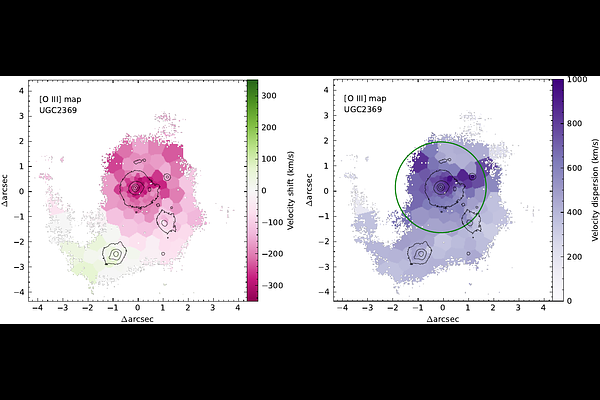
AbstractWe present high spatial resolution ($\lesssim$1.0''), multi-wavelength observations of UGC 2369S, a nearby luminous infrared galaxy showing three distinct cores separated on kpc scales in near-infrared (NIR) imaging with significant X-ray emission. Utilizing optical/NIR adaptive optics (AO), radio, \chandra X-ray, as well as archival HST imaging, we perform a comprehensive study of AGN activity, obscuration, and host properties. As one of the clearest cases of a triple-nucleus merger at $\simeq$3 kpc separations, UGC 2369S is the first to be studied with high-resolution observations at multiple wavelength. We find that the northern core, having possibly the most massive black hole in the system ($\rm M_{BH}\simeq10^{8}\,M_{\odot}$) is consistent with a heavily obscured AGN. However, its high dust extinction ($\rm A_v>5$), hydrogen column density ($N_\mathrm{H}\gtrsim 10^{25}\,\rm cm^{-2}$) and non-detection of optical coronal lines and coronal X-ray emission leave the identification inconclusive. The other two cores show no evidence for black-hole activity and instead exhibit signatures of tidal disruption. From stellar mass surface density and stellar velocity dispersion maps, we infer that the strongly varying gravitational potential in this three-body system may have cannibalized the stellar bulge of the southwestern core, leaving a metal enriched remnant. An ongoing survey focusing on similar triple systems could help us understand how they evolve and help benchmark numerical simulations, providing insight into gravitational wave predictions and the formation of the most massive black holes.