The CGM with local universe FRBs: evidence of strong AGN feedback in a massive elliptical galaxy

The CGM with local universe FRBs: evidence of strong AGN feedback in a massive elliptical galaxy
Samuel McCarty, Liam Connor, Ralf M. Konietzka
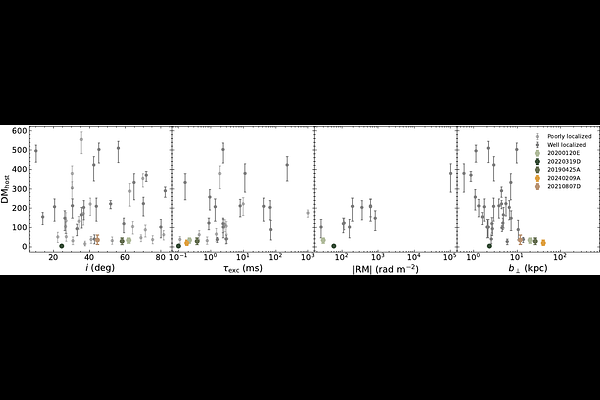
AbstractModern cosmology and galaxy formation rely on an understanding of how cosmic baryons are distributed, a significant portion of which exist in the diffuse gas confined to halos. Fast Radio Bursts (FRBs) are a promising probe of the Universe's ionized gas. At low redshift, the contribution to the dispersion measure (DM) from the intergalactic medium (IGM) and intervening halos is subdominant, allowing us to study the circumgalactic media (CGM) of the host galaxies. We select a sample of five local universe FRBs whose host interstellar medium (ISM) DM is negligible and use these to constrain the mass of the CGM in each halo. We find that one of our sources, the only massive elliptical host galaxy, has been evacuated of its baryons ($M_\mathrm{gas}=0.02^{+0.02}_{-0.02}M_\mathrm{h}$, corresponding to $\sim$10$\%$ of the cosmological average $\frac{Ω_b}{Ω_m}$). This galaxy shows evidence of a past episode of AGN activity, consistent with the picture of strong AGN feedback in galaxy group-scale halos. The other sources are consistent with existing multiwavelength data and tentatively support more baryon retention in $L_*$ galaxies compared to group-scale halos. We show that FRBs can measure the halo gas fraction $f_\mathrm{gas}$ in halos of mass $M_\mathrm{h}\sim10^{11-13}M_\odot$, and up to $\sim10^{14}M_\odot$ if galaxy cluster hosts are included, which is a larger range than other gas probes can access. Finally, we demonstrate that a large sample of local universe FRBs, such as those expected from upcoming all-sky radio telescopes, will enable precision measurements of halo gas, which is crucial for understanding the effects of feedback.