A high-resolution X-ray view of the ultra-fast outflow in MAXI J1810-222

A high-resolution X-ray view of the ultra-fast outflow in MAXI J1810-222
C. Pinto, M. Del Santo, A. D'Aì, F. Pintore, T. D. Russell, M. Parra, J. Ferreira, P. -O. Petrucci, K. Fukumura, A. Marino, T. Muñoz-Darias, G. A. Rodríguez Castillo, A. Segreto
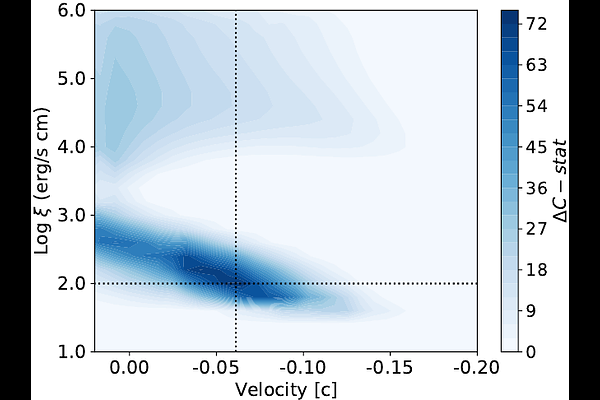
AbstractIn previous work, it was reported that the Galactic black hole candidate MAXI J1810-222 exhibited a notable absorption spectral feature at around 1 keV in low-resolution X-ray spectra of CCD-like detectors. The feature was correlated with the spectral state of the source, being stronger in the soft states, as it occurs in the typical Fe K winds of X-ray binaries (XRBs). However, the results hinted towards rather extreme wind velocities of up to ~0.1 c. We therefore requested and obtained an observation with XMM-Newton to take advantage of the 10-fold higher spectral resolution (R ~200-400) provided by the RGS detector in order to resolve the lines and break the degeneracy between different models and interpretations. We applied state-of-the-art models of plasma in photoionisation equilibrium and multiphase interstellar medium. Further comparisons are performed with a re-analysis of NICER and NuSTAR data. The XMM-Newton/RGS spectrum is consistent with the presence of a mildly relativistic wind, confirming the earlier indications obtained with NICER, but places tighter constraints on the outflow properties, with the lines being intrinsically broad. The data would then favour magnetically driven winds, although thermal effects may still contribute to mass loading. NuSTAR and XMM-Newton (EPIC) show a further hotter component indicating a stratified or multiphase outflow. Fe K spectra taken with calorimetric detectors (e.g., Resolve on XRISM) will enable a high-resolution view of the complex extreme outflow in this source and shed new light on outflow processes in XRBs.