Boltz-Flow: Generating High-Quality Robot Action from Boltzmann Machine

Boltz-Flow: Generating High-Quality Robot Action from Boltzmann Machine
Hengzhi Jiang, Haixu Liu, Jindou Jia, Tinglan Wang, Shaobo Chen, Yiren Zhao, Ziyang Rao, Laiyuan Cui, Jiaxin Dong, Yin Ma, Hai Wei, Jiaqi Bai, Tuo An, Xinyu Zhou, Hao Ban, Hongdong Zhu, Yanqi Wang, Jiaqi Dou, Nuo Qian, Qi Liu, Bin Jin, Chang Wu, Qingfeng Li, Hui Yang, Weiyu Guo, Dicong Qiu, Qi Gao, Jianwei Niu, Kai Wen, Jianfei Yang
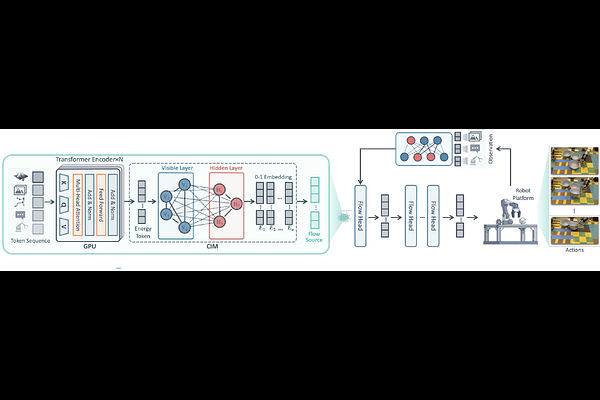
AbstractFlow-matching policies integrate a velocity field from a fixed, observation-independent Gaussian source. However, since the source is unimodal and identical across all tasks, the limited representational capacity of Gaussian distributions constrains how far a policy can scale with growing task diversity. Moreover, the source factorizes over time steps and control dimensions, discarding the coordination that manipulation requires. We introduce Boltz-Flow, which replaces Gaussian initialization with a more powerful, observation- and instruction-conditioned Boltzmann source while leaving the base VLA unchanged. Boltz-Flow parameterizes this source with a conditional Boltzmann machine that assigns an energy value to each binary source state. A listwise objective, supervised entirely by offline demonstrations, aligns this energy with the quality of actions produced after frozen flow integration. At inference, the energy defines an Ising instance whose solution is decoded into continuous noise before a single standard integration. We use a physical coherent Ising machine during training. Experiments show that Boltz-Flow improves $π_{0.5}$ across three benchmarks, outperforming the compared strong policy baselines and competing noise optimization methods on LIBERO and RoboTwin 2.0 and ranking second only to LEAP on LIBERO-Plus. Additional experiments show gains under noise-adapted fine-tuning, with action-to-action warm starts, and on the SmolVLA backbone.