Spectral and photometric variability of SS 433 observed with XRISM and simultaneous optical and near-infrared telescopes

Spectral and photometric variability of SS 433 observed with XRISM and simultaneous optical and near-infrared telescopes
Yusuke Sakai, Shinya Yamada, Yuta Okada, Toshihiro Takagi, Tomoya Usuki, Megumi Shidatsu, Shogo B Kobayashi, Robert Petre, Yoshihiro Ueda, Hideki Uchiyama, Miho Tan, Taro Kotani, Taichi Igarashi, Mami Machida, Haruka Sakemi, Nobuyuki Kawai, Daiki Miura, Hiroya Yamaguchi, Kanta Fujiwara, Daichi Hiramatsu, Keisuke Isogai, Chulsoo Kang, Mariko Kimura, Katsuhiro L Murata, Takahiro Nagayama, Taichi Nakamoto, Kosuke Namekata, Yuki Niida, Yuu Niino, Masafumi Niwano, Kyuseok Oh, Shigeyuki Sako, Mahito Sasada, Hiromasa Suzuki, Kenta Taguchi, Ichiro Takahashi, Miyu Uenishi, Yoichi Yatsu, Marina Yoshimoto
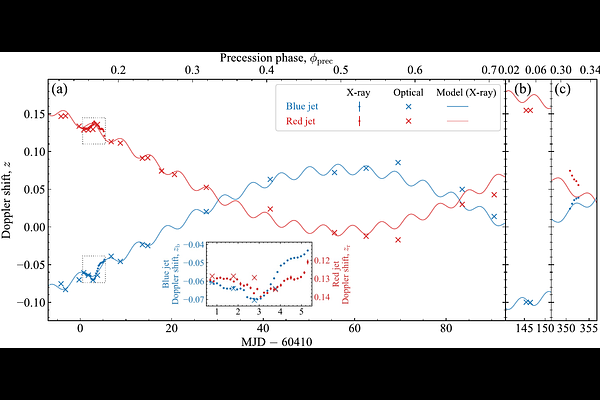
AbstractWe present results from coordinated multiwavelength observations of the SS 433, obtained with XRISM, optical telescopes, and near-infrared camera during 2024 April and 2025 March. The XRISM exposures amounted to ~200 ks in 2024 and ~100 ks in 2025. With XRISM/Resolve's high spectral resolution and large effective area, we clearly resolved numerous emission lines even in short time segments, achieving improved accuracy in Doppler-shift measurements relative to earlier observations. The simultaneously obtained X-ray and optical Doppler shifts suggest a possible tendency for the optical emission to lag slightly behind the X-rays. In the Resolve data, the Doppler shifts of the two jet components exhibited apparent asymmetries, with jet speeds fluctuating around ~0.26$\pm$0.01$c$ in 2024 and ~0.30$\pm$0.01$c$ in 2025. The velocity variations indicated modulations on a timescale of ~6.3 d, with a phase offset of about -90$^{\circ}$ relative to the nutation cycle. The observed line widths and flux of the approaching and receding jets appear consistent with the expected geometrical effects, indicating systematically larger line widths in the inner regions of the jets, as proposed by Shidatsu et al. (2025). Optical light curves show flares of ~400 s in 2024 and ~1600 s in 2025, with amplitudes up to ~15% during out-of-eclipse intervals, while the XRISM/Xtend light curves show no significant variability within the overlapping intervals and given the statistical uncertainties. Near-infrared photometry in 2024, obtained during an out-of-eclipse interval at a different epoch from the optical observations, showed no flare-like variability, and the X-ray band also remained constant within uncertainties. These coordinated observations provide a foundation for future XRISM studies aimed at probing the dynamical properties of the relativistic jets in SS 433.