Magnetoacoustic Shocks and Spectropolarimetric Signals in He I 10830 Å

Magnetoacoustic Shocks and Spectropolarimetric Signals in He I 10830 Å
Hirdesh Kumar, Tobias Felipe, Christoph Kuckein, S. J. González Manrique, A. Asensio Ramos
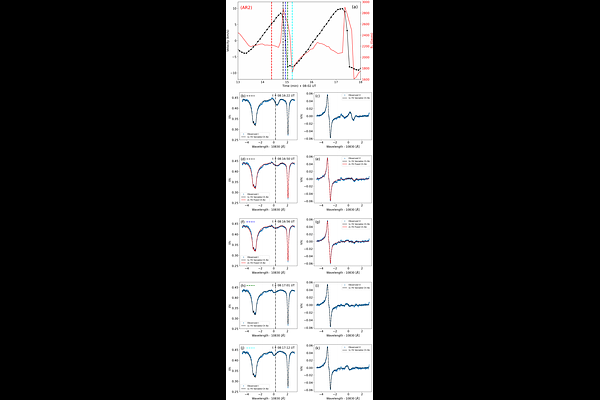
AbstractUmbral flashes are manifestations of magnetoacoustic shocks in the solar chromosphere. These phenomena are thought to influence the evolution of chromospheric umbral magnetic fields. However, the impact of these shocks on inferred chromospheric magnetic field oscillations remains unclear. We examined five different sunspots located near the solar disk center, observed with the GRIS instrument installed at the GREGOR telescope. The HAZEL2 Spectropolarimetric inversion code is used to obtain the photospheric and chromospheric line-of-sight velocities and magnetic fields in Si 10827 Å and He 10830 Å spectral lines, respectively, using various inversion strategies. In the inversions with one chromospheric component, three of the sunspots exhibit remarkably stronger magnetic fields accompanying the shocks, while the other two sunspots show striking reductions in the magnetic field. Alternatively, the Stokes profiles can be reproduced by models with two chromospheric slabs, one on top of the other, through two-component inversions. These inversions provide excellent fits even when magnetic field fluctuations are discarded by imposing a constant magnetic field during the whole temporal series. In this scenario, the observed Stokes profiles are interpreted as the result of strong velocity gradients, where the He 10830 Å line is sensitive to both sides of the shock front. Both competing models explaining the spectral profiles during the shocks, either large magnetic field fluctuations or velocity gradients, are critically discussed.