Time-Domain Deep Learning for Pairwise Identification of Strongly Lensed Gravitational-Wave Candidates

Time-Domain Deep Learning for Pairwise Identification of Strongly Lensed Gravitational-Wave Candidates
Fan Zhang, Qikai Zhang, Qiyuan Yang, Jiaqing Huang, Yong Yuan, Xilong Fan
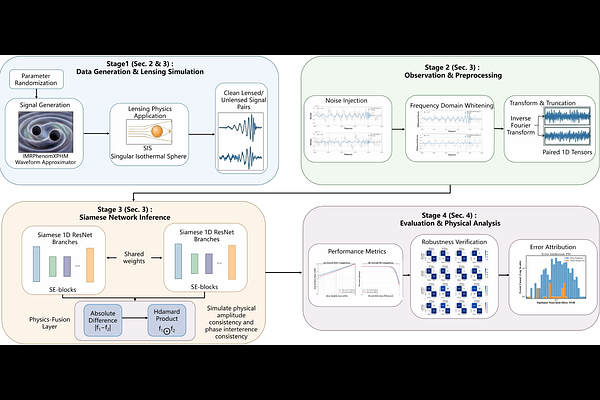
AbstractAs gravitational wave (GW) catalogs continue to expand, exhaustive Bayesian comparisons of candidate event pairs become increasingly computationally expensive, which motivates the development of fast prescreening methods for strongly lensed GW searches. We formulate lensed-pair identification as a binary verification problem using two preprocessed strain segments. To address this task, we propose Physics-Inspired ResNet (PI-ResNet), a Siamese one-dimensional residual network for pairwise GW candidate classification. Unlike spectrogram-based prescreening approaches, PI-ResNet operates directly on whitened time-domain strain data and avoids an intermediate time--frequency image representation. A shared residual backbone with Squeeze-and-Excitation (SE) modules encodes the two input segments, and the paired embeddings are compared through absolute feature differences and Hadamard-product interactions. We train and evaluate the model using simulated GW signals from binary black hole mergers lensed by point-mass (PM) and singular isothermal sphere (SIS) lenses, injected into simulated LIGO and Einstein Telescope (ET) detector noise. Under ET design noise, PI-ResNet achieves accuracies of $95.60\%$ for SIS lenses and $93.80\%$ for PM lenses, while maintaining $84.03\%$ and $78.25\%$ accuracy under simulated LIGO H1--L1 Gaussian noise. These results suggest that direct learning from 1D strain data provides an efficient and physically motivated preselection statistic for candidate lensed GW pairs, while also indicating the need for detector-domain adaptation.