SciWorkBench: A Benchmark for Real Scientific Workflows

SciWorkBench: A Benchmark for Real Scientific Workflows
Yuchen Zhang, Taolin Han, Jinghang Wang, Jinxin Wang, Yun Wu, Wai Yuet Chiu, Xiaogang Li, Yuting Fu, Kewei Sun, Jiaxin Li, Qile Jin, Jiajia Li, Ruodan Chen, Qingteng Chen, Jialu Nie, Junchao Li, Yifei Zhang, Chen Zhao, Hu Wei, Lin Qu, Yanni Yin, Bing Zhao
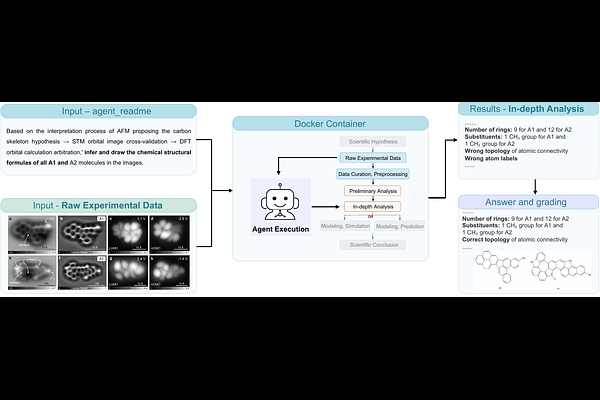
AbstractLanguage models are increasingly being used as agents capable of planning and executing projects, as well as refining their actions through feedback. This shift raises a question: can current agents complete projects like real scientists? To examine this question, we introduce SciWorkBench, a benchmark for evaluating agents' abilities on real science tasks across biology, chemistry, materials science, and physics. SciWorkBench is built from peer-reviewed literature or expert-contributed research scenarios. We also propose a unified scientific analysis framework validated by domain experts, which can categorize most tasks in SciWorkBench. Each task covers one or more stages of this framework. We evaluate up-to-date models within the Claude Code and Codex agent frameworks under a unified execution and grading protocol. The best-performing agent achieves a mean score of 57.38, indicating that current agents still struggle with realistic scientific workflows. Our failure analysis identifies three recurring weaknesses at the workflow level: difficulty translating scientific knowledge into task-specific procedures, weak integration of evidence across different modalities, and limited capacity for scientific self-correction. These findings highlight the importance of workflow-based evaluation for measuring progress toward reliable AI systems for scientific research.