Discovery of an Inflated Hot Neptune and Its Formation from Jovian Mass Loss

Discovery of an Inflated Hot Neptune and Its Formation from Jovian Mass Loss
Grant C. Weldon, Samuel W. Yee, Bradley M. S. Hansen, Smadar Naoz, Joel D. Hartman, Joshua N. Winn, R. Paul Butler, Jeffrey D. Crane, Phil Evans, Tianjun Gan, Steve B. Howell, Michelle Kunimoto, David Osip, David Rapetti, Stephen A. Shectman, Keivan G. Stassun, Johanna K. Teske, Roberto Zambelli, George Zhou, Carl Ziegler
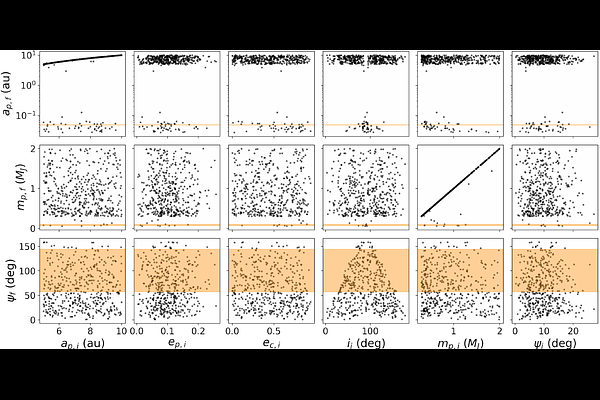
AbstractThe production of Neptune-like planets with orbital periods of 3--6 days is challenging for conventional models of high-eccentricity migration. We present the discovery and characterization of TOI-2195~A~b, an inflated hot Neptune ($P = 4.16$ days, $m_p= 1.46M_{\rm Nep},\,R_p = 0.79R_{\rm J}$) orbiting an early K-type star with a wide binary companion at $\sim 600$~au. Detection of the Rossiter-McLaughlin effect at $\sim2.6σ$ confidence with Magellan/PFS reveals the planet is likely on a near-polar orbit with a sky-projected stellar obliquity $λ= {109^{+35}_{-53}} ^{\circ}$. We perform coupled dynamical and structural modeling that reproduces the observed characteristics of the system. We show that the planet may have originated as a cold, Jovian planet that was excited to high eccentricities via the stellar Eccentric Kozai-Lidov (EKL) mechanism, where it lost up to $\sim90\%$ of its mass via Roche lobe overflow during close periastron passages, enabling rapid tidal migration and radius inflation due to tidal heating. TOI-2195 A b provides a test for planetary migration theories, and our simulations suggest that puffy hot Neptunes originated as more massive Jovians that underwent mass loss during high-eccentricity migration.