BLADE: Auditing Information Use for Failure Attribution in LLM Multi-Agent Systems

BLADE: Auditing Information Use for Failure Attribution in LLM Multi-Agent Systems
Xiaoguang Guo, Yaohao Long, Chuxu Zhang
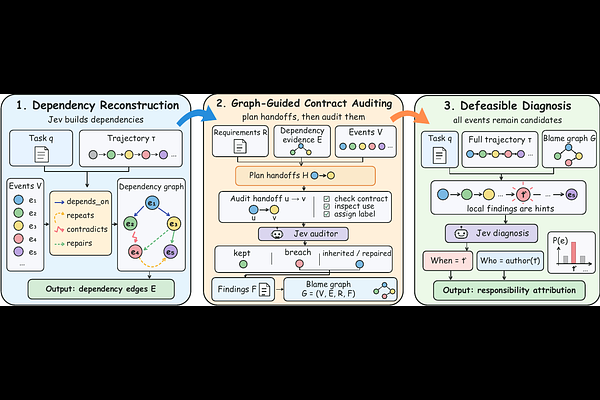
AbstractLarge language model multi-agent systems extend individual agents' capabilities through collaboration across specialized roles, tools, and workflows. Yet collaboration makes failures harder to diagnose: one agent may misinterpret a correct result while others carry the mistake forward. Failure attribution therefore seeks to identify the responsible agent and decisive error step. Recent methods trace dependencies, but knowing where information came from is not the same as knowing where it went wrong. We introduce BLADE (Blame Localization via Audited Dependency Evidence), a training-free framework that moves beyond tracing information to auditing its use. Using Jev for structured probabilistic judgments, BLADE uses dependency probabilities to select relevant source-decision handoffs for auditing. At these handoffs, it examines whether receiving decisions use their sources faithfully and within task requirements, distinguishing error introduction, propagation, and repair. These findings inform a global diagnosis that considers all execution steps. Without reference answers, BLADE achieves the best or tied-best step accuracy among eight strategies under a shared Jev decision interface on 1,228 failed runs across five Who&When and Who&When Pro subsets, outperforming All-at-once by 2.2-11.1 percentage points. Making responsibility evidence explicit offers a path toward more interpretable and reliable agentic systems.