An Afterglow Study of the "New Year's Burst" GRB 220101A

An Afterglow Study of the "New Year's Burst" GRB 220101A
Agniva Roychowdhury, Tuomas Kangas, Andrew Fruchter, A. Pe'er, K. Bhirombhakdi, J. Graham, K. Misra, A. J. Levan, B. Cenko, A. Cucchiara, V. Cunningham, B. P. Gompertz, D. Perley, J. Racusin, N. R. Tanvir
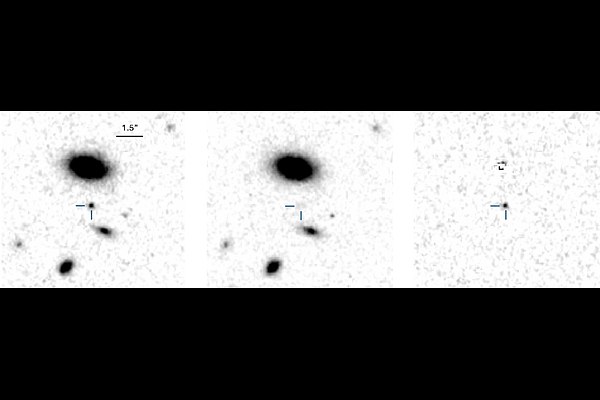
AbstractWe present a detailed broadband afterglow study of GRB 220101A ($10^4\lesssimΔT\lesssim10^7$ s) combining multi-wavelength data from soft X-rays until 6 GHz. The afterglow light curves in both X-ray and optical show distinct steepening around $\sim9$ days, followed by a sharp post-break decay index of $\sim2.99\pm0.10$. We fit the light curves using the afterglow modelling package \texttt{afterglowpy} for both Top-hat and Gaussian jets for different values of the electronic participation fraction $ξ$ from 0.01 to 1.0 and find that, although the radio behavior is well described by the $ξ=1.0$ case, the required circumburst medium (CBM) densities are very low, $<10^{-4}$ cm$^{-3}$. However, the resulting energy requirements are modest, $\sim10^{52}$ erg, with an electron energy distribution (EED) index $p\sim2.05$. Similar results are also obtained from an analytic model fit to the light curve, except the predicted $p$ is higher, $\sim2.40$. The observed post-break decay index of $2.99$ is at least 5$σ$ away from $p$, which is one of the steepest observed so far. We also find that when ignoring the radio observations, the CBM density is raised by a few orders of magnitude to $\sim0.01$ cm$^{-3}$ for $ξ=1.0$, still far from the expected ISM density ($>1$ cm$^{-3}$) of GRB environments, which are highly star forming regions. Similarly low ISM densities have been seen in modeling of other LAT GRBs as well, especially ones with reverse-shock features (e.g., GRBs 130427A, 160509A and 160625B), thereby hinting at either an issue with the standard model or possible evacuated cavities where GRBs explode.