Weak buoyancy and cold lithospheres decouple interior melting from seafloor volcanism on icy ocean worlds

Weak buoyancy and cold lithospheres decouple interior melting from seafloor volcanism on icy ocean worlds
Nahiz Hestaphin
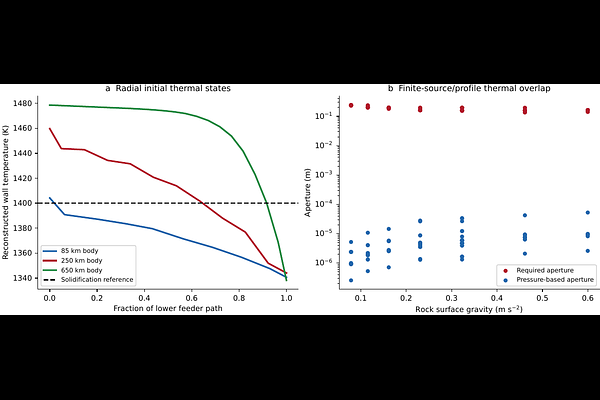
AbstractOn icy ocean worlds, deep silicate melting can generate sufficient pressure to open fractures while magma freezes before reaching the ocean. We identify a coupled transport regime by linking finite melt segregation and nonlinear rock relaxation to fracture flow, crystallisation and the ice-loaded ocean boundary. In a hot Europa endmember, increasing grain size from 1 to 10 mm raises relaxed excess pressure from 5.55 kPa to 10.2 MPa, overcoming the inherited-fracture opening threshold despite weak buoyancy. For the same 100 m strike and 0.5 m aperture, the cold first-fill rate required by heat balance increases from 0.17-0.69 m3 s -1 over terrestrial crustal distances of 1.1-4.5 km to 15-29 m3 s -1 across 89-171 km Europa paths, far above the self-supplied flow. Higher ice-ocean pressure further reduces the enthalpy margin of near-solidus magma in the adopted basalt phase law. During approximately 5 kyr of dormancy, the collector pressure returns to its relaxed value, while upper-path walls cool to 275-282 K and the magma path loses liquid connectivity. In two focused Europa histories with mechanically supported pathways, delivery of 0.005 km3 of magma over 0.1 Myr requires 14-27 km3 of sacrificed magma-equivalent preparation material. Weak gravity, extensive cold rock and a pressurised ocean thus make seafloor access a history-dependent process governed by thermal connectivity and its renewal, decoupling recurrent volcanism from melt production at depth.