Determining the Spin-down of the White Dwarf in J191213.72-441045.1 using Optical Time-Series Photometry

Determining the Spin-down of the White Dwarf in J191213.72-441045.1 using Optical Time-Series Photometry
Callum J. Hodge, Ingrid Pelisoli, A. J. Brown, N. Castro Segura, V. S. Dhillon, M. J. Dyer, J. A. Garbutt, M. J. Green, D. Jarvis, M. R. Kennedy, P. Kerry, S. P. Littlefair, J. McCormac, J. Munday, S. G. Parsons, E. Pike, D. I. Sahman, A. Yates, T. Zivave
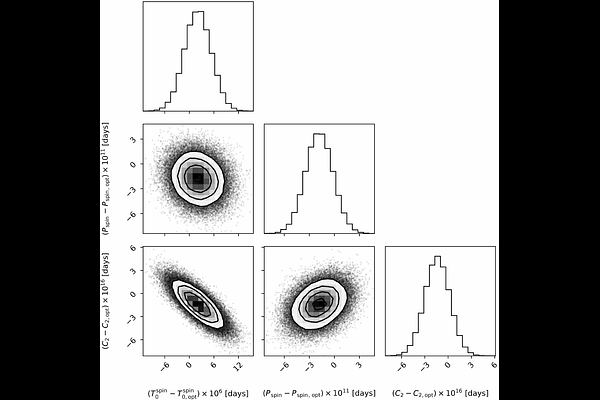
AbstractJ191213.72-441045.1 (J1912-4410) is the second white dwarf pulsar to be discovered. These binary systems consist of a white dwarf primary with a cool companion and undergo pulsed emission from radio to X-ray wavelengths. The prototype of the class, AR Scorpii (AR Sco), exhibits a lack of accretion, which led to suggestions that the spin-down of the white dwarf is powering the system's non-thermal emission. However, J1912-4410 displays possible signatures of accretion, which allows for the possibility that its emission may operate via a different mechanism to AR Sco. To investigate this, we determined the first estimate for the spin period derivative of J1912-4410 from optical photometric data. This was carried out using ULTRACAM observations in multiple bandpasses spanning the last four years. Our estimate for the spin period derivative of 4.13(8)e-12 s/s is consistent across the u, g and r bandpasses of ULTRACAM. The corresponding spin-down power of 9^{+6}_{-5}e25 W is approximately equal to previous estimates for the system's bolometric luminosity. This suggests that the non-thermal emission of J1912-4410 is not solely powered by its spin-down, as near-perfect efficiency would be required. Additionally, our spin period derivative indicates that J1912-4410 is unlikely to be consistent with the synchronar model proposed to explain the emission of AR Sco, given previous upper limits for the white dwarf's magnetic field. Our findings imply that J1912-4410 has a distinct emission mechanism compared to AR Sco, which, if true, means that white dwarf pulsars are a heterogeneous class of binary systems.