The First Systematic Survey of Stellar Halos in High-Inclination Galaxies Reveals Unusually Quiescent Merger Histories of Nearby Galaxies

The First Systematic Survey of Stellar Halos in High-Inclination Galaxies Reveals Unusually Quiescent Merger Histories of Nearby Galaxies
Bojun Tao, Hong-Xin Zhang, Wenting Wang, Enci Wang, Guangwen Chen, Huiyuan Wang, Lijun Chen, Qian-Hui Chen, Song Huang, Xu Kong, Yu Rong
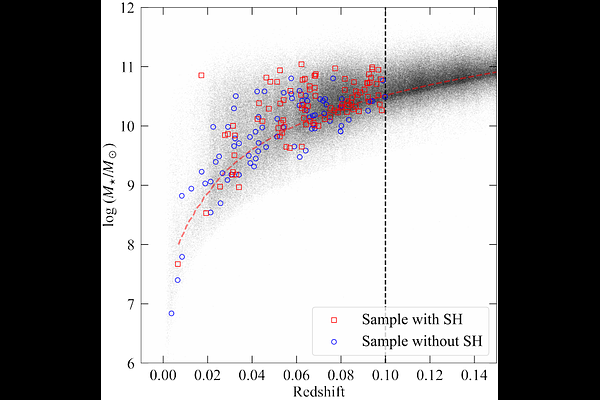
AbstractStellar halos are the only major stellar component of disk galaxies that lack systematic observational characterization, yet they encode critical information about galaxy merger histories. We present the first systematic census of stellar halos in a large, flux-limited sample of 169 high-inclination central galaxies with stellar masses 7.3 <= log Mstar/Msun <= 11.0 and redshift z < 0.1, using HSC-SSP Deep optical images. Stellar halos are detected in 93 galaxies, primarily through their low isophotal ellipticities in the outskirts, improving upon conventional methods of stellar halo identification. The halo detection rate reaches ~ 50% at log Mstar/Msun > 9.9 and >= 70% for Milky Way (MW)-mass galaxies. We derive halo surface brightness profiles, colors, and masses, finding that stellar halos generally follow power-law radial profiles. Higher-mass galaxies, on average, exhibit smaller power-law indices and larger halo mass fractions, indicating more extended halos and more active merger histories. A significant stellar halo color-mass correlation, driven mainly by the mass-metallicity relation, suggests dominance by a few massive accretion events. MW-mass galaxies have a median stellar halo fraction of 10% +/- 5%. Among nearby galaxies with halo measurements within 25 Mpc, two thirds (including the MW) lie below the mean stellar halo fraction-galaxy mass relation. Overall, the nearby galaxies show a median halo deficit of ~ 0.3 dex, implying unusually quiescent merger histories. We show that this deficit follows a broader trend in which typical halo fractions increase with heliocentric distance, tracking the gradual rise in matter density toward the cosmic average by z <= 0.07.