Morphological complexity of NGC 628 - a multiwavelength multiscale analysis using the ordinal pattern framework

Morphological complexity of NGC 628 - a multiwavelength multiscale analysis using the ordinal pattern framework
Athokpam Langlen Chanu, S Amrutha, Pravabati Chingangbam, Changbom Park
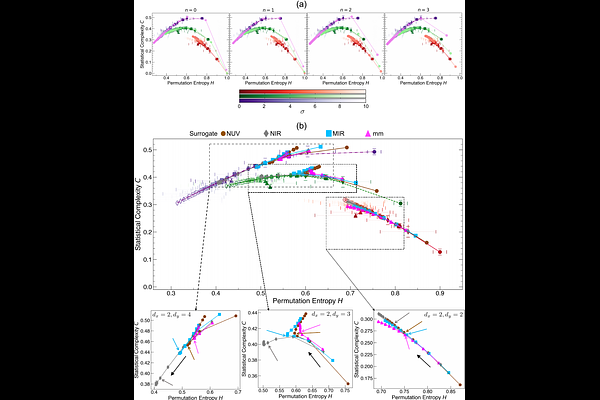
AbstractAs statistical systems, galaxies exhibit a rich interplay between organized structure and stochastic fluctuations across a broad range of spatial scales. This duality motivates the need for quantitative frameworks capable of capturing their morphological complexity. The ordinal patterns framework, along with its associated statistical measures: permutation entropy ($H$), disequilibrium ($D_E$), statistical complexity ($C$), and ordinal network node entropy, has recently emerged as a powerful tool for analyzing such complexity in physical systems. We apply this framework in a multiwavelength, multiscale analysis of the galaxy NGC 628, utilizing observations in the near-ultraviolet, near-infrared, mid-infrared, and millimeter bands. Our results reveal a characteristic spatial scale of approximately 200 parsecs, marking the transition from small-scale structures influenced by star formation and stellar feedback to larger-scale morphology governed by the galaxy's dynamics. Furthermore, we find that the $C$ vs. $H$ trajectories for all wavelengths converge toward a common attractor curve, consistent with the behavior of isotropic Gaussian random fields. This convergence suggests a universal statistical behavior in galactic structure at large scales, despite the differing physical processes traced by each wavelength.