The Mysterious Case of Iron in XMPs: Anomalous High log(Fe/O) Observed in Extremely Metal-Poor Galaxies HSCJ1631+4426 and SDSSJ0811+4730

The Mysterious Case of Iron in XMPs: Anomalous High log(Fe/O) Observed in Extremely Metal-Poor Galaxies HSCJ1631+4426 and SDSSJ0811+4730
Aaron Myszka, Themiya Nanayakkara, Karl Glazebrook, Sarah M. Sweet, Brent Groves, Nikole M. Nielsen, Jarle Brinchmann, Yuki Isobe, Chiaki Kobayashi, Haruka Kusakabe, Michael V. Maseda
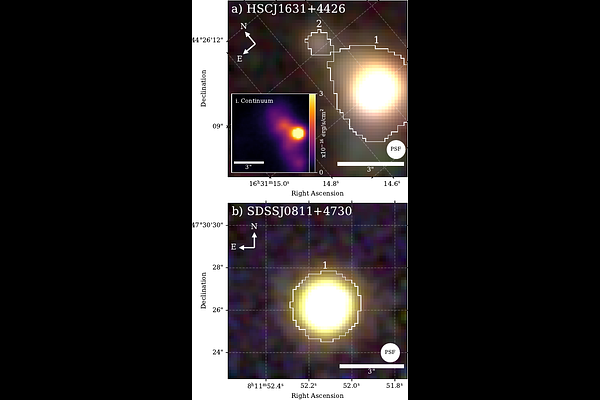
AbstractWe present integral field spectroscopic observations of two local extremely metal-poor galaxies (XMPs), HSCJ1631+4426 and SDSSJ0811+4730, obtained with the Keck Cosmic Web Imager (KCWI) over the wavelength range $3545-5529$ Å at a spectral sampling of 0.5 Å, capturing bright nebular emission lines essential for determining gas-phase metallicity and chemical enrichment measurements. Using integrated spectra, we derive oxygen abundances of $\rm12+\log(O/H)=7.079\pm0.010$ and $6.926\pm0.004$, and elevated Fe/O ratios of $\rm\log(Fe/O)=-1.57\pm0.17$ and $-1.28\pm0.07$, for HSCJ1631+4426 and SDSSJ0811+4730 respectively. Each galaxy is fully contained within the $\sim$8'' field of view, with 0.15'' spaxels providing spatially resolved information. These measurements indicate unusually efficient iron enhancement at extremely low metallicity; Fe/O ratios approach or exceed solar despite oxygen abundances of only $\sim$2% solar, inconsistent with enrichment from core-collapse supernovae alone or delayed Type Ia supernovae given the young ages of the systems. Comparison with chemical evolution models suggests rare, highly energetic explosions such as bright hypernovae and/or pair-instability supernovae are likely responsible. Our results reinforce the growing evidence that XMPs can reflect the nucleosynthetic processes of early energetic stellar explosions, serving as local laboratories for chemical enrichment pathways prevalent in the early Universe.