VENUS: A Census of Strong Lensing in a 60-Cluster JWST Survey

VENUS: A Census of Strong Lensing in a 60-Cluster JWST Survey
Joseph F. V. Allingham, Lukas J. Furtak, Miriam Golubchik, Ashish K. Meena, Adi Zitrin, John Chisholm, Seiji Fujimoto, Vasily Kokorev, Abdurro'uf, Franz E. Bauer, Maruša Bradač, Gabriel Brammer, Dan Coe, José M. Diego, Henry C. Ferguson, Steven L. Finkelstein, Tiger Yu-Yang Hsiao, Yolanda Jiménez-Teja, José M. Palencia, Gregor Rihtaršič, Chris Willott, Rogier A. Windhorst, Hollis B. Akins, Ricardo O. Amorín, Larry D. Bradley, Chloe M. Cheng, Christopher J. Conselice, David A. Coulter, Pratika Dayal, Guillaume Desprez, Miroslava Dessauges-Zavadsky, Andreas L. Faisst, Qinyue Fei, Brenda Frye, Yuichi Harikane, Jeyhan S. Kartaltepe, Tomokazu Kiyota, Conor Larison, Paulo A. A. Lopes, Ray A. Lucas, Georgios E. Magdis, Nicholas S. Martis, Masami Ouchi, Richard Pan, Casey Papovich, Massimo Pascale, Justin D. R. Pierel, Tom Resseguier, Johan Richard, Massimo Ricotti, Luke Robbins, William Sheu, Fengwu Sun, Felix Vecchi, Brian Welch, Hiroto Yanagisawa
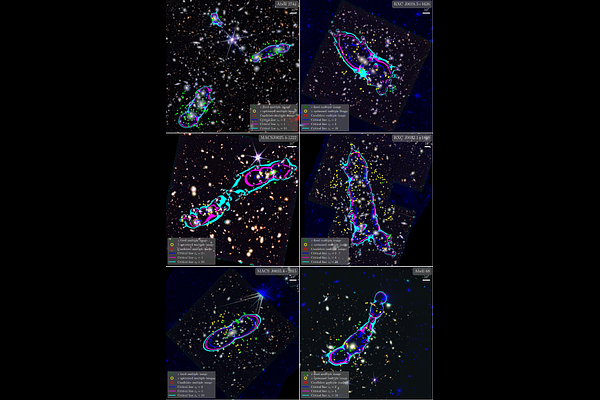
AbstractWe present strong-lensing models for the 57 galaxy clusters observed in Cycle 4 out of the 60 targeted by the JWST Vast Exploration for Nascent, Unexplored Sources (VENUS) program. Models for the remaining three clusters will be incorporated after their observations. The dataset comprises 5013 individual images, corresponding to 1733 multiply-imaged systems, of which 912 have spectroscopic redshift measurements and 227 are newly identified. Using this new wealth of observations, we construct parametric lens models with our $\mathtt{AstroLensPy}$ software, reproducing the observed image positions with an average image-plane precision $Δ_{\rm RMS}$ of $0.54''$. With a total imaging area of $576$ arcmin$^2$, VENUS offers the largest homogeneous set of cluster strong-lensing models to date. The clusters yield a combined area of $191$ arcmin$^{2}$ magnified by $|μ|\geq3$ for a source $z_s=10$, for example, establishing the VENUS fields as a premier survey for high-redshift studies. Among our sample, the clusters MACS J0717.5+3745, RXC J0600.1-2007 and PLCK G287.0+32.9 display the largest Einstein radii ($\geq 60''$) and magnified areas ($\mathcal{A}_{z_s=10}^{|μ|\geq3} \geq 9$ arcmin$^2$) for a source $z_s=10$, and therefore constitute the most potent gravitational telescopes known to date. Finally, leveraging the statistical power of the sample, we derive scaling relations between various lensing observables (Einstein radius, magnified area, projected mass) and the SZ/X-ray-inferred cluster mass, $M_{500,c}$.