Complex Interplay between Outer Disk Dynamics and Inner Water Reservoir

Complex Interplay between Outer Disk Dynamics and Inner Water Reservoir
Feng Long, Ilaria Pascucci, Paola Pinilla, Andrea Banzatti, Adrien Houge, Sean M. Andrews, Doug Johnstone, Gregory J. Herczeg, Joan Najita, Klaus M. Pontoppidan, Joe Williams, Ke Zhang, Geoffrey A. Blake, Maria Jose Colmenares, Giovanni Rosotti, Enrico Ragusa, Colette Salyk, Chengyan Xie, Tayt Armitage, Xue-Ning Bai, Daniel Harsono, Till Kaeufer, Sebastiaan Krijt, Giuseppe Lodato, Yao Liu, Carlo F. Manara, Francois Menard, Mayank Narang, Miguel Vioque, David J. Wilner, the JDISCS Collaboration
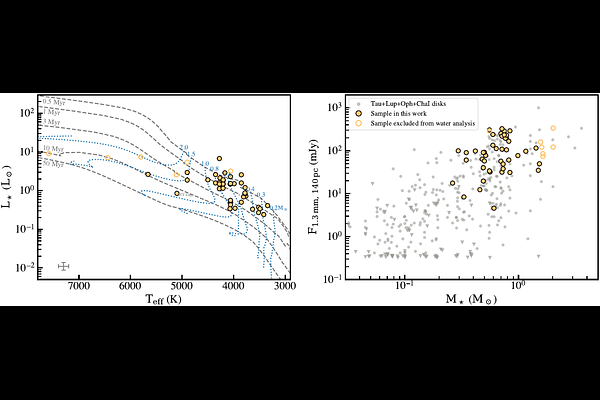
AbstractWe present a homogeneous characterization of outer disk dust and gas properties for 51 protoplanetary disks from the JWST/MIRI Cycle 1 programs, combining new ALMA observations with archival data. Visibility fitting with frank recovers more and higher-contrast substructures in the mm continuum than image-plane analysis, placing the innermost features of several disks at 4-5 au and leaving only three disks featureless at the current resolution. CO gas disk sizes span $\sim$60-1000 au and correlate strongly with mm continuum sizes, with $R_{\rm CO}/R_{\rm mm}$ ranging from 1.4 to 9.7 (median 2.95). We then connect these outer disk properties to JWST/MIRI inner disk water diagnostics. We find no global correlation between the cold-to-hot water flux ratio ($F_{\rm cold}/F_{\rm hot}$), a proposed proxy of cold water enrichment by pebble transport, and any single outer disk parameter, including $R_{\rm mm}$, $R_{\rm CO}/R_{\rm mm}$, and innermost substructure location. Three compact ($R_{\rm mm}<30$ au), structureless disks with $R_{\rm CO}/R_{\rm mm}>4$ show both elevated $F_{\rm cold}/F_{\rm hot}$ and cold water emission near the snowline temperature, consistent with unimpeded inward drift of icy pebbles. For structured disks, the water properties instead vary widely at fixed gap location, reflecting the sensitivity of the inner disk water content to multiple factors, including gap leakiness, grain size, and thermal history. Linking outer disk dust evolution to inner disk water content thus requires carefully selected samples with detailed constraints on these additional parameters.