Comprehensive In Situ Characterization of Amorphous Solid Water Films with COSPINU2 set-up: Optical Properties, Density, Morphology, and Restructuring Dynamics

Comprehensive In Situ Characterization of Amorphous Solid Water Films with COSPINU2 set-up: Optical Properties, Density, Morphology, and Restructuring Dynamics
Delfina Toulouse, Japhar Michoud, Sasha Cryan, Arya M. Nair, Pascal Jeseck, Patrick Marie-Jeanne, Géraldine Féraud, Mathieu Bertin, Jean-Hugues Fillion, Xavier Michaut
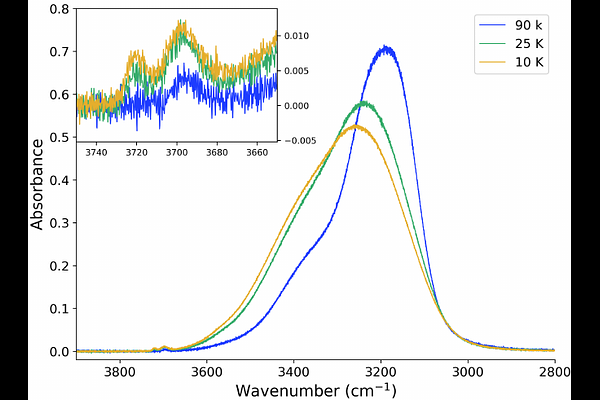
AbstractAmorphous solid water (ASW) dominates interstellar ice mantles, but its porosity, density, optical response, and mechanical stability depend sensitively on how the ice is grown. Here, we present the characterization capabilities of COSPINU2, a cryogenic ultra-high-vacuum set-up designed to prepare and diagnose water ice films under controlled background and doser-assisted deposition conditions. The instrument combines a calibrated gas-handling line, near- and mid-infrared Fourier-transform infrared spectroscopy, HeNe interferometry, broad-beam optical imaging, and quadrupole mass spectrometry. We demonstrate how these complementary diagnostics provide a coherent description of ASW films grown between 10K and 150K. For background-grown ices, a dual-angle interferometric method is used to retrieve refractive indices near 632 nm, while near-infrared interference fringes provide thickness calibration. The results show that lower deposition temperatures and higher growth rates produce films with lower refractive indices and stronger dangling-OH infrared signatures, consistent with the formation of more porous ASW. We also show that pressure-based density estimates are unreliable in the background geometry because cryopumping decouple chamber pressure from the local substrate flux. For doser-grown films, optical interference imaging allows reconstruction of dome-shaped thickness profiles and estimation of effective densities. Finally, sudden restructuring events are observed in thick (above 2 micrometers), low-temperature porous ASW films, evidenced by abrupt changes in interferometric contrast, optical scattering, and dangling-OH features. These results establish COSPINU2 as a versatile platform for quantitative water-ice characterization and provide the physical baseline required for future studies of infrared irradiation and optical constants of interstellar ice analogues.