How many VHE gamma-ray binaries with young pulsars can be observed?

How many VHE gamma-ray binaries with young pulsars can be observed?
A. M. Bykov Ioffe PTI, StPetersburg, A. G. Kuranov Sternberg Astronomical Institute, Moscow, A. E. Petrov Ioffe PTI, SPb, K. A. Postnov SAI Moscow
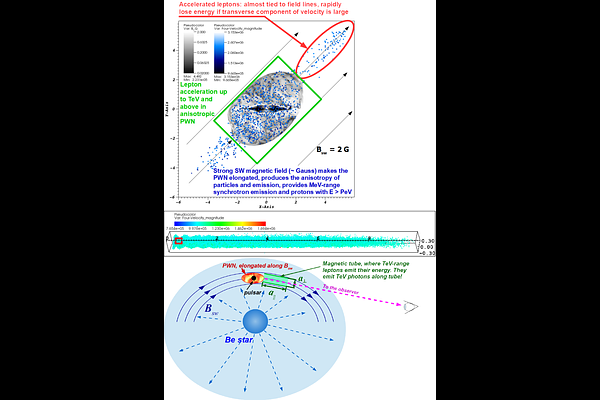
AbstractA population of Galactic gamma-ray binaries is currently emerging due to ever increasing sensitivity of gamma-ray observatories. The detection of very high energy (VHE) photons with energies well above 10 TeV from a dozen of sources and the estimated power of those sources make them potentially interesting cosmic ray accelerators. Multi-wavelength observations of gamma-ray binaries revealed that most of them include a young massive star in pair with a relativistic companion, either a black hole or energetic pulsar. Fast stellar winds interacting with powerful relativistic outflows from pulsars or the black hole jets in microquasars are favorable sites for VHE particle acceleration. To estimate the expected number of gamma-ray binaries, we present results of population synthesis calculations of Galactic binaries in which a young massive OB- or Be-star is accompanied by a pulsar capable of producing a powerful relativistic outflow. The distributions over the binary eccentricities, orbital periods, Be-disk inclinations, and the pulsar braking energy losses are taken into account. Conditions for a binary to accelerate VHE particles, radiate and absorb the non-thermal photons that may reach the observer are discussed. We model the anisotropic structure of the zone of interaction of the relativistic pulsar wind with the strongly magnetized massive star's wind. The stellar winds with strong ($\sim$ Gauss) magnetic fields at $\sim$ AU distances colliding with powerful pulsar outflows are capable of accelerating particles up to PeV energies at some orbital configurations and phases. The strong magnetic field in the interaction region produces a highly anisotropic structure of the particle accelerator and emitter in the pulsar outflow. The anisotropic radiation pattern may affect the gamma-ray photon absorption and the number of the observed gamma-ray loud systems.