Cosmic voids evolution in modified gravity via hydrodynamics

Cosmic voids evolution in modified gravity via hydrodynamics
Tommaso Moretti, Noemi Frusciante, Giovanni Verza, Francesco Pace
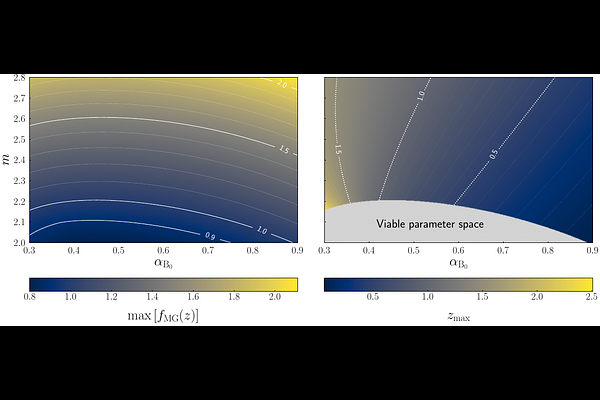
AbstractWe present a hydrodynamical description of spherical void evolution in modified gravity (MG), extending the standard General Relativity (GR) and dynamical dark energy treatment by encoding gravity modifications into effective couplings that enter the Euler and Poisson equations. This yields a compact non-linear evolution equation for the Eulerian density contrast, controlled by a time- and density-dependent effective gravitational strength, and provides a direct map between model functions and void observables. We apply the framework to the luminal Galileon class of models, where derivative self-interactions generate Vainshtein screening and might lead to a breakdown of the physical branch in sufficiently underdense regions. Exploiting this feature, we apply the void-informed viability requirement that translates into bounds on the theory parameter space and, equivalently, on the minimum attainable void depth as a function of redshift. For viable parameters of a concrete model, we quantify the impact of MG on isolated void evolution, the Lagrangian to Eulerian mapping, and the shell-crossing threshold. Relative to GR, we find a clear hierarchy of MG effects, with ${\cal O}(10\%)$ modifications in the gravitational couplings, percent-level shifts in the void density evolution, and sub-percent deviations in both the mapping and the shell-crossing thresholds. Moreover, within the adopted parametrization, we show analytically that voids always lie in an unscreened regime on the physical branch. Overall, the formalism provides a self-consistent route to predict void dynamics and consistency constraints in a broad class of MG models.