A Tale of Two Type IIb Supernovae: Radio-loud and Radio-silent Candidate Counterparts to Sub-solar Mass Gravitational-wave Triggers

A Tale of Two Type IIb Supernovae: Radio-loud and Radio-silent Candidate Counterparts to Sub-solar Mass Gravitational-wave Triggers
Tanner O'Dwyer JHU, Alessandra Corsi JHU, Raphael Baer-Way NRAO, Mansi M. Kasliwal Caltech, Poonam Chandra NRAO, David L. Kaplan UWM, Kunal P. Mooley IITK, Deepika Yadav IITK
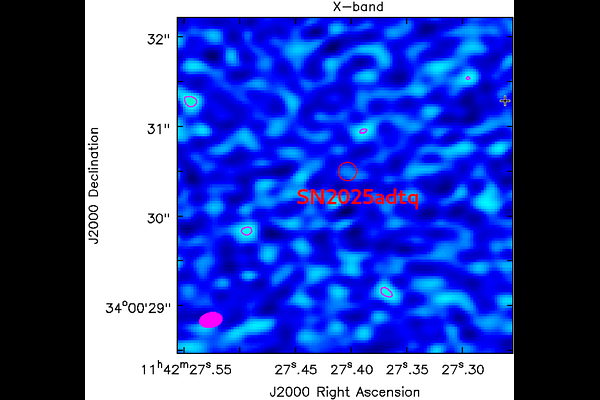
AbstractOn 2025 November 12, the LIGO-Virgo-KAGRA collaboration reported S251112cm, a gravitational-wave (GW) candidate from a compact binary merger with at least one sub-solar-mass component. Optical follow-up identified SN 2025adtq, a Type IIb supernova (SN) within the localization volume that exploded a few days before the merger. SN 2025adtq is the second Type IIb SN found to be potentially coincident with a sub-solar-mass GW candidate, after SN 2025ulz (S250818k). A key question is whether such SNe harbor fast, possibly collimated ejecta from a central engine, as invoked in ``superkilonova'' scenarios for forming sub-solar-mass neutron stars. We present deep Karl G. Jansky Very Large Array observations of SN 2025adtq from the JAGWAR program, spanning 139-216 days after the GW trigger at 6-10 GHz. The radio properties of SN 2025adtq differ substantially from those of SN 2025ulz: whereas SN 2025ulz has a significant 6-10 GHz counterpart, SN 2025adtq remains undetected to 3sigma limits of ~7.8 uJy, implying a radio luminosity density one order of magnitude below that of SN 2025ulz at a comparable epoch, excluding jet models that remained viable for SN 2025ulz. This diversity in radio properties calls for systematic multi-wavelength follow up observations of candidate sub-solar events in future runs of the LIGO-Virgo-KAGRA detectors.