The rise and fall of 1A 1118-61: First evidence for frequency hysteresis of quasi-periodic oscillations in an X-ray pulsar

The rise and fall of 1A 1118-61: First evidence for frequency hysteresis of quasi-periodic oscillations in an X-ray pulsar
Alexander Salganik, Sergey S. Tsygankov, Sergey V. Molkov, Hua Xiao, Lingda Kong, QingChang Zhao, Long Ji, Alexander A. Mushtukov, Igor Yu. Lapshov, Alexander A. Lutovinov, Alexey Yu. Tkachenko, Hua Feng, Shuang-Nan Zhang, Xiao-Bo Li, Shu Zhang, Juri Poutanen
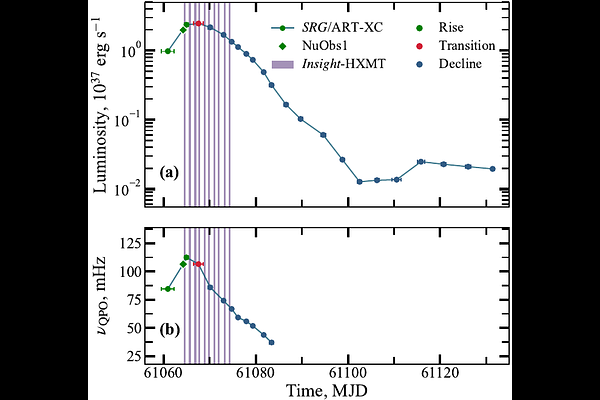
AbstractContext. Quasi-periodic oscillations (QPOs) are commonly observed in accreting X-ray pulsars (XRPs), but the physical mechanisms governing their frequency evolution remain poorly understood. Aims. We investigate the evolution of the QPO during the 2026 outburst of the Be/X-ray pulsar 1A 1118-61, focusing on its frequency-luminosity relation during the rising and declining phases of the outburst. Methods. We analyzed X-ray timing and spectral observations obtained with SRG/ART-XC, NuSTAR, and Insight-HXMT. We measured QPO centroid frequencies and amplitudes, compared their evolution during the rising and declining phases of the outburst, and examined the associated changes in the X-ray spectral shape. Results. We detected a prominent QPO with a centroid frequency ranging from approximately 37 to 114 mHz. Its frequency-luminosity relation follows two distinct branches, with QPO frequencies approximately 35% higher during the rise than during the decline at the same luminosity. The frequency evolution along both branches is consistent with Keplerian motion near the inner disk edge. The X-ray spectral shape also follows different evolutionary tracks during the rising and declining phases. Conclusions. We report the first evidence for QPO frequency hysteresis in an XRP. The observed separation between the rising and declining branches suggests that the characteristic timescale of the QPO depends not only on the instantaneous luminosity but also on the accretion history. We discuss possible implications for the disk-magnetosphere interaction.