X-ray Analysis and Photon-transport Simulations of SMC X-1: A Warped-disc Origin of the Superorbital Modulation

X-ray Analysis and Photon-transport Simulations of SMC X-1: A Warped-disc Origin of the Superorbital Modulation
Satoshi Takashima, Hirokazu Odaka, Ryota Tomaru, Atsushi Tanimoto, Aya Bamba, Toru Tamagawa
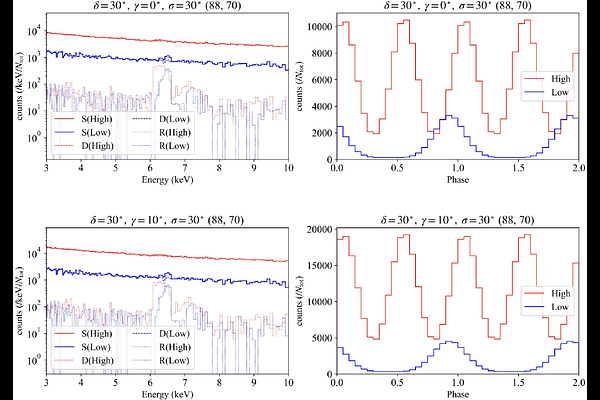
AbstractThe luminous accreting pulsar SMC X-1 is an appropriate target to explore the accretion dynamics. SMC X-1 shows unique quasi-periodic flux variability of 40-65$\,$days known as superorbital modulation. To constrain the accretion structure of SMC X-1 based on timing and spectral study, we have analysed X-ray data of SMC X-1 observed by Suzaku and NuSTAR at various epochs between 2011 and 2022. The spectral analysis shows that the hydrogen column density ($N_\mathrm{H}$) increases from $1.1 \times 10^{22}\,\mathrm{cm^{-2}}$ to $1.24 \times 10^{23}\,\mathrm{cm^{-2}}$ as the flux decreases with the superorbital modulation. The neutral iron K$α$ line at 6.4$\,$keV has a broad width of 0.3$\,$keV, and its equivalent width increases as toward superorbital low states. The line broadening is consistent with Keplerian motion at the inner disc rather than the stellar wind velocity of the donor star. These findings support that the superorbital modulation is a consequence of X-ray attenuation by the warped accretion disc. To test this interpretation, we have conducted photon transport simulations of a system consisting of a neutron star, a warped disc, and optically-thin disc atmosphere. Occultation of the central source by the disc successfully reproduces the observed variations in the equivalent width of neutral iron K$α$ line, pulse profiles, and flux in hard X-rays. Notably, a disc precession angle of approximately $30^\circ$ can account for the observational features. For the radiation pattern of the photon source, the preferred beam width corresponds to a standard deviation of $30^\circ$.