GSE vs. LMC: reshaping of radially biased stellar haloes by satellites

GSE vs. LMC: reshaping of radially biased stellar haloes by satellites
Adam M. Dillamore, Jason L. Sanders, Richard A. N. Brooks
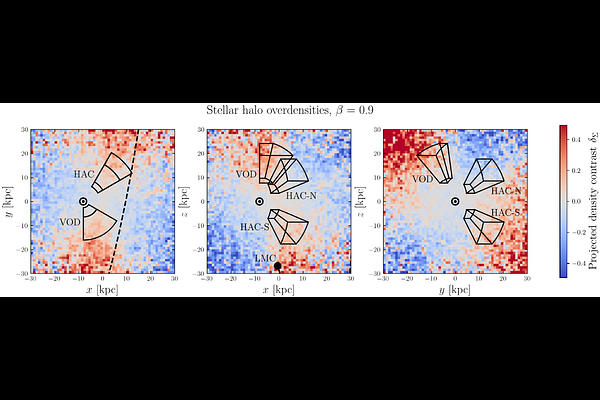
AbstractPerturbations from the Large Magellanic Cloud (LMC) of the Milky Way's stellar and dark matter haloes are well-established. However, studies have generally not considered haloes with high radial anisotropy, like debris from the Gaia Sausage-Enceladus (GSE) in the Milky Way. We run a series of test particle simulations of stellar haloes with different velocity anisotropies $β\in[0.5,0.9]$. The LMC causes these initially axisymmetric haloes to become approximately triaxial. Their major axes are aligned with its orbital plane and tilted by up to $\sim14^\circ$ with respect to a fixed Galactic disc. These effects become much more dramatic as $β$ increases, causing the halo to fractionate spatially according to anisotropy. This confirms the expectations of an analytical model, which predicts that orbits with eccentricities $e\gtrsim0.95$ should azimuthally align with the tidal field of the LMC. The reshaping of the $β=0.9$ halo creates strong overdensities of $\sim40\%$ at heliocentric distances as close as 15 kpc. These coincide with the well-known Virgo Overdensity (VOD) and Hercules-Aquila Cloud (HAC), which have previously been associated with the GSE. We propose that the HAC and VOD were created by the dynamical alignment of highly eccentric orbits by the LMC, and are not necessarily relics of the GSE merger geometry. We conclude that previous works have significantly underestimated perturbations from the LMC in the inner stellar halo by not considering sufficiently high velocity anisotropy. This effect should be corrected for when constructing equilibrium models of the GSE.