Kerr Black Hole Shadows in Dispersive Plasma: Frequency-Dependent Geodesics and Shadow Distortions

Kerr Black Hole Shadows in Dispersive Plasma: Frequency-Dependent Geodesics and Shadow Distortions
Sai Karan Mukthapuram Indian Institute of Science Education and Research Pune, India, Sandeep Kumar Kataria Indian Institute of Technology Kanpur, India
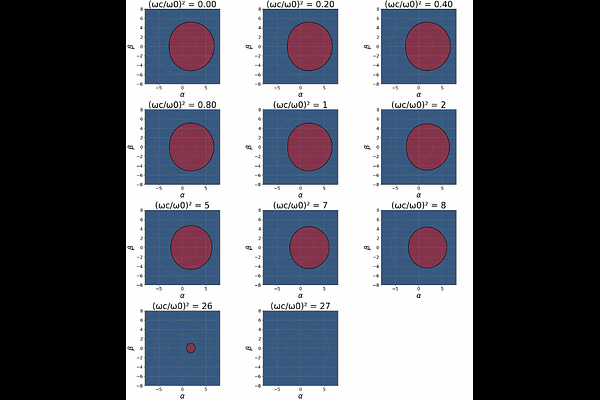
AbstractThe black hole shadow, a direct probe of the event horizon's gravitational influence, has been observationally confirmed by the Event Horizon Telescope (EHT). While theoretical models of shadows in vacuum are mature, real astrophysical black holes like M87* and Sgr A* are enveloped in plasma, which can alter photon trajectories through dispersion. Current understanding, based on foundational work, indicates that only specific plasma distributions allow for an analytical treatment via the separation of the Hamilton-Jacobi equation. In this work, we build upon this framework to systematically investigate the propagation of light rays in Kerr spacetime surrounded by a pressureless, non-magnetized cold plasma. We explicitly derive the separability condition, identifying the exact class of plasma densities that permit a generalized Carter constant. For these models, we compute the photon regions and shadow boundaries, characterizing how the shadow's size and shape deviate from the vacuum case in a frequency-dependent manner. Our results provide analytical benchmarks for the distortion of shadows in dispersive media and determine the critical plasma frequency beyond which the shadow is erased, offering a direct link between observable shadow features and the properties of the ambient plasma environment and providing a foundation for studying more dynamic, non-separable plasma distributions.