Imploding Remnants: detection bias against AGNs in massive clusters

Imploding Remnants: detection bias against AGNs in massive clusters
Ross J. Turner, Georgia S. C. Stewart
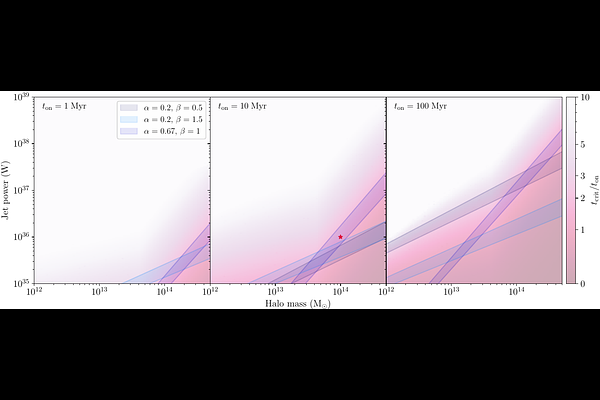
AbstractWe propose that an observed scarcity of remnant lobed AGNs in dense clusters results from a peculiarity in their dynamics upon the cessation of jet activity: a rapid `implosion' of lobes that, in their active phase, were primarily supported by the momentum flux of the jet. We investigate this behaviour by analysing the asymptotic behaviour of the RAiSE dynamical model and comparing our predictions both to the full model and hydrodynamic simulations. We find that remnant lobes powered by weak jets in massive clusters are unstable to implosion on the order of at most a few Myr. Consequently, remnant AGNs in massive clusters ($M_\text{halo} \sim 10^{14.5}$~M$_\odot$) will be under-counted by a factor of at least five compared to those in poorer groups ($M_\text{halo} \sim 10^{12}$~M$_\odot$). The lack of such remnants in observed populations may lead to a significant underestimate of the AGN feedback provided by low-powered jets, especially given their prevalence towards cluster cores where feedback is most effective. We discuss the influence of a stabilising magnetic field sheath on the nature of the implosion: does the lobe cleanly implode in on itself, or do fluid instabilities turbulently mix the lobe and ambient medium?