Spirited Away: Advective Loss of Cosmic Rays into the Milky Way's Circumgalactic Medium Explains the Large Magellanic Cloud's Low Gamma-ray Luminosity

Spirited Away: Advective Loss of Cosmic Rays into the Milky Way's Circumgalactic Medium Explains the Large Magellanic Cloud's Low Gamma-ray Luminosity
Taaseen Islam, Hilay Shah, Mark R. Krumholz, Roland Crocker
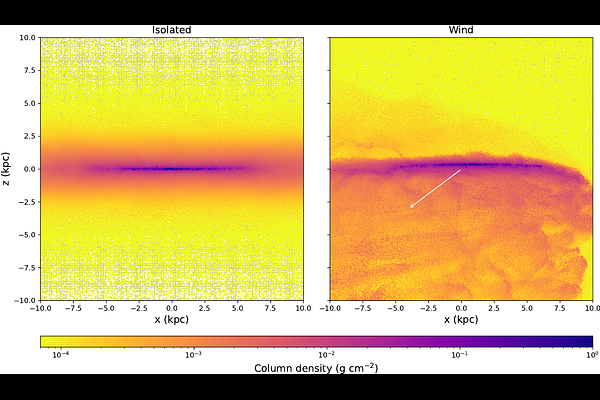
AbstractModels of galactic-scale cosmic ray production and transport have successfully reproduced the radio and $γ$-ray spectra of many galaxies; however, one notable exception is the Large Magellanic Cloud (LMC), where models that successfully fit other galaxies consistently overestimate its $γ$-ray flux. Here we investigate this discrepancy by applying the CRIPTIC cosmic ray transport code to recent magnetohydrodynamic simulations of the LMC's interactions with the Milky Way circumgalactic medium that accurately reproduce observations of the LMC's magnetic field structure. We recover a simulated $γ$-ray luminosity that is close to the observed luminosity for a wide range of cosmic ray transport models, while our control simulations of an isolated LMC not interacting with the Milky Way show the same over-prediction problem as previous investigations. Simulations including the CGM interaction yield lower $γ$-ray luminosities because in them cosmic rays escape the galaxy primarily via advection, significantly decreasing the emission from collisional processes and changing the dominant $γ$-ray emission mechanism from pion decay to inverse Compton emission. Comparisons of the detailed spectral shape show that our interacting LMC models match the observed $γ$-ray spectrum at photon energies below $\sim 10$ GeV, but still slightly overestimate the flux at higher energies, suggesting either more strongly energy-dependent transport than the models we have explored, or a cosmic ray injection spectrum steeper than the $p^{-2.2}$ that we adopt.