Independent Recovery of Vanishing Sources on POSS-I Photographic Plates Using Automated Source Detection and Cross-Epoch Matching

Independent Recovery of Vanishing Sources on POSS-I Photographic Plates Using Automated Source Detection and Cross-Epoch Matching
Zachary Hayes
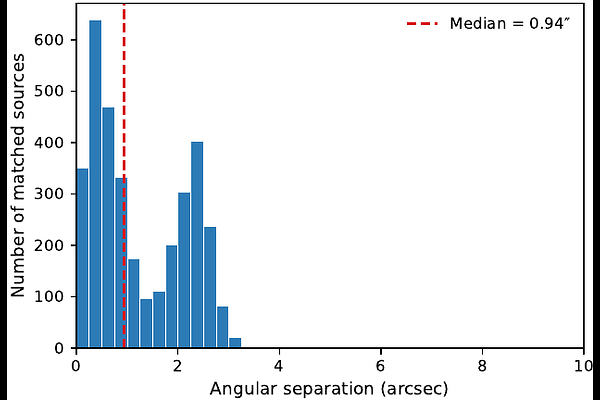
AbstractWe present an independent pipeline for detecting candidate vanished sources on digitized first-epoch Palomar Observatory Sky Survey (POSS-I) photographic plates. The pipeline detects and PSF-filters sources on POSS-I Red DSS cutouts, applies local astrometric registration refinement, and identifies candidates by cross-epoch matching against POSS-I Blue and POSS-II Red with Pan-STARRS DR1 rejection. On a 20-case benchmark harness, the pipeline recovers 8/9 sources in the April 1950 field and 3/3 in the July 1952 field, with a false positive rate of about 0.2 per 10 arcmin field on random non-crowded controls. A full-footprint sweep over the POSS-I coverage using 30 arcmin patches yields a filtered catalog of 2.85 million candidate vanished sources after post-processing PSF cuts, deduplication, and Pan-STARRS DR1 rejection. Cross-matching against the published 5,399-source Solano et al. (2022) catalog yields 3,450 matches (63.9%) with median separation 0.94 arcsec; among unrecovered catalog entries within our footprint, we find no Pan-STARRS DR1 counterpart within 3 arcsec. Applying Bruehl and Villarroel (2025)-style temporal windows to this catalog over the 368 POSS-I observation nights in the 1949-1957 interval gives a post-test calendar-day relative risk of 1.35 for the +1 day window, but the effect is not statistically significant (95% CI 0.91-2.00; two-sided Fisher p = 0.17) and is sensitive to coding unobserved days as zero-transient days. A negative binomial model of nightly candidate counts with nightly patch coverage as exposure is likewise null (IRR = 1.03, 95% CI 0.89-1.18, p = 0.71). The catalog-level replication is strong; the temporal association remains inconclusive.