Modelling of post-reconstruction galaxy clustering with a hybrid bias expansion

Modelling of post-reconstruction galaxy clustering with a hybrid bias expansion
Vicente Izzo Dominguez, Raul E. Angulo, Antonio D. Montero-Dorta, Marcos Pellejero-Ibáñez
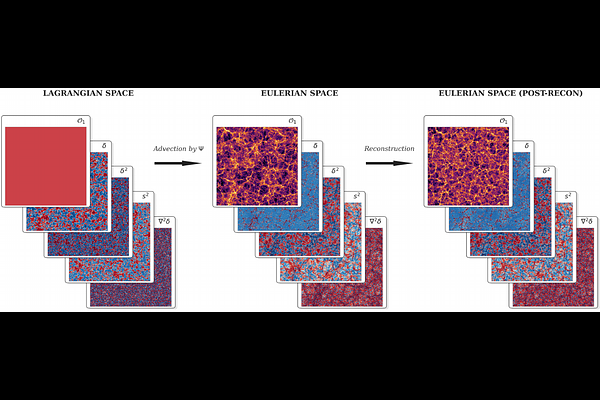
AbstractDensity-field reconstruction sharpens the baryon acoustic oscillation (BAO) feature and recovers part of the cosmological information lost from two-point statistics through nonlinear evolution. Exploiting reconstructed clustering beyond BAO measurements requires modelling nonlinear evolution and galaxy formation physics. We extend the hybrid Lagrangian bias expansion to post-reconstruction galaxy clustering in configuration space and determine its range of validity. We apply a single reconstruction displacement to each Eulerian basis field of a second-order hybrid expansion, retaining the same bias parameters before and after reconstruction. We fit the correlation-function multipoles of subhalo abundance-matching mocks in real and redshift space, considering RecIso and RecSym, and use a Fisher analysis to forecast constraints on $σ_8$ and $Ω_{\rm m}$. The model reproduces the pre- and post-reconstruction multipoles for $r>35 h^{-1}\mathrm{Mpc}$ with a single set of Lagrangian bias parameters. For a $3 h^{-3}\mathrm{Gpc}^3$ volume at $z\simeq0$ with $\bar{n}=5\times10^{-4} h^3\mathrm{Mpc}^{-3}$, post-reconstruction clustering (POST) alone tightens the marginalised constraint on $Ω_{\rm m}$ by a factor of $\sim1.3$ relative to pre-reconstruction clustering (PRE), but slightly weakens that on $σ_8$ when the reconstruction bias is inferred from the observed clustering amplitude. Combining PRE and POST reduces both marginalised uncertainties by about one third and increases the figure of merit by a factor of $\sim2.2$, mainly by breaking degeneracies between bias and cosmology. Pre- and post-reconstruction clustering contain complementary cosmological information and can be modelled within the same hybrid Lagrangian bias expansion. The framework is well suited to emulation and future joint full-shape analyses of galaxy surveys.