A Statistical-AI Framework for Detecting Transient Flares in SDSS Stripe 82 Quasar Light Curves

A Statistical-AI Framework for Detecting Transient Flares in SDSS Stripe 82 Quasar Light Curves
Atal Agrawal
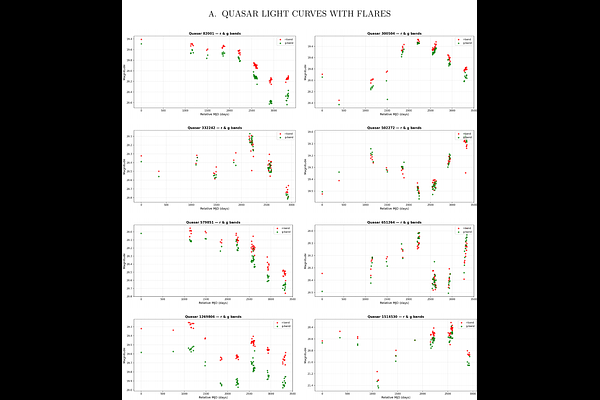
AbstractQuasars exhibit stochastic variability across wavelengths, typically well-described by a Damped Random Walk (DRW). However, extreme luminosity changes, known as quasar flares, represent significant departures from this baseline and offer crucial insights into accretion disc dynamics and the fundamental physics of supermassive black hole fueling. While transient surveys have spurred interest in flare detection, a systematic search within the legacy SDSS Stripe 82 dataset -- containing 9,258 confirmed quasars -- has not yet been performed. The primary statistical challenge lies in distinguishing these rare events from ever-present intrinsic noise. To address this, we present FLARE (Flare detection via physics-informed Learning, Anomaly scoring, and Recognition Engine), a generalized three-stage framework for detecting flares present in quasar data. FLARE operates by modeling baseline DRW behavior, applying anomaly scoring to flag potential flares, and utilizing a recognition engine to verify candidates. For Stripe 82, we implement this framework using a physics-informed probabilistic Gated Recurrent Unit (GRU) for baseline modeling, Extreme Value Theory (EVT) for anomaly detection, and benchmarking various open-weight and proprietary Vision Language Models as recognition engines for final verification. Detection is executed on r-band light curves, with candidates cross-checked against g-band data to definitively rule out instrumental artifacts. Applying this pipeline, we successfully identify 27 quasars exhibiting distinct flaring activity.