An Updated Characterization of Luminous Lyα emitters at the End of Reionization

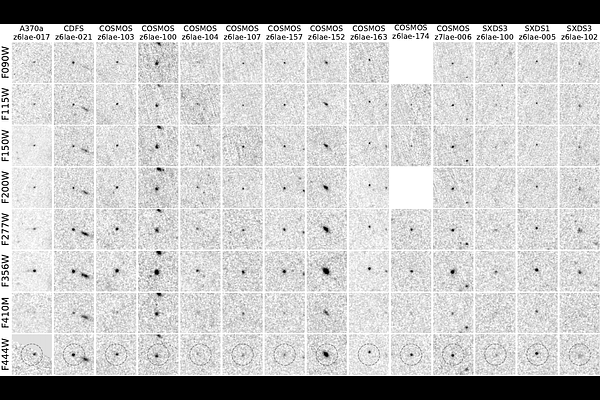
An Updated Characterization of Luminous Lyα emitters at the End of Reionization
Yuanhang Ning, Zheng Cai, Linhua Jiang, Yucheng Guo, Qiong Li, Si-Yue Yu, Xiaodi Yu, Zhen-Ya Zheng
AbstractWe present a multi-wavelength physical characterization of 14 luminous Ly$α$ emitters (LAEs) at $z\approx6$, integrating deep ground-based Magellan/M2FS spectroscopy with heterogeneous JWST/NIRCam broad- and medium-band imaging. Identified via strong Ly$α$ lines with extreme Ly$α$ luminosities of ${>}10^{42.6}$ erg s$^{-1}$, the sample exhibits very large rest-frame equivalent widths (${\gtrsim}100$ Å) and steeply blue UV continua ($β_{\rm median}\simeq-2.2$, $-18.2>M_{\rm 1500}>-20.2$ mag). Crucially, the integration of NIRCam medium-band photometry (F410M) breaks the degeneracy between strong rest-optical nebular emission and Balmer breaks, resolving prior mass overestimations. The tightly constrained spectral energy distribution modeling demonstrates that these luminous LAEs tend to be unequivocally low-mass, ultra-young dwarf starbursts; half the sample is characterized by stellar masses of $M_* < 10^8 M_{\odot}$, ages $\lesssim10$ Myr, and negligible dust attenuation. We also map the production efficiency of ionizing photons and Ly$α$ escape fractions ($f_{\rm esc}^{\rm Lyα}$). The $f_{\rm esc}^{\rm Lyα}$ values are exceptionally high, with a median of ${\gtrsim}40$%, increasing for the bluer UV continua. Finally, analyzing spatial offsets between the Ly$α$ centroid and the stellar counterpart, we demonstrate empirically that internal dust content, rather than neutral hydrogen gas, dominate the suppression of Ly$α$ radiative transfer. Our study reveals that strong Ly$α$ emission of the luminous LAEs are generally attributed to both the vigorous starburst activities and the high $f_{\rm esc}^{\rm Lyα}$. Resembling Lyman continuum leakers, these extreme dwarf systems function as highly efficient ionizing engines at the conclusion of the Epoch of Reionization.