GEMS JWST: A sub-Solar metallicity atmosphere for giant planet TOI-5293Ab orbiting a rapidly changing M-dwarf

GEMS JWST: A sub-Solar metallicity atmosphere for giant planet TOI-5293Ab orbiting a rapidly changing M-dwarf
Shubham Kanodia, Caleb I. Cañas, Jacob Lustig-Yaeger, Giannina Guzmán Caloca, Nicole L. Wallack, Simon Müller, Ravit Helled, Knicole D. Colón, Ian Czekala, Megan Delamer, Te Han, Jessica Libby-Roberts, Anjali A. A. Piette, Kevin B. Stevenson, Gudmundur Stefansson, Johanna Teske
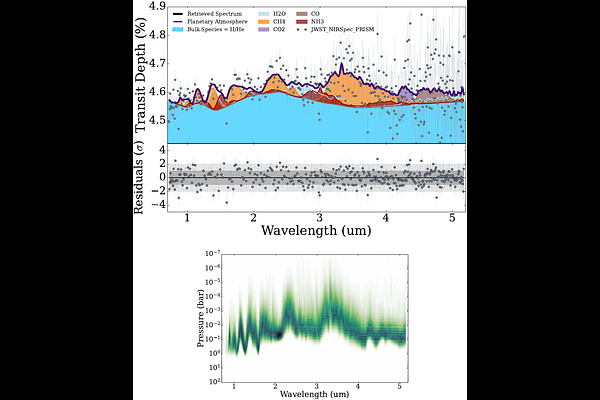
AbstractThe growing sample of Giant Exoplanets around M-dwarf Stars (GEMS) helps probe the extremes of giant planet formation. Comparing the properties of this sample with their FGK counterparts can help us understand how planet formation and migration depend on stellar mass. We initiated a large Cycle 2 JWST transmission spectroscopy survey of seven GEMS. Here we present the atmospheric characterization using two JWST transits of TOI-5293Ab, a 0.5 $M_J$ planet orbiting an early M-dwarf with a period of $\sim$ 3 days. The two NIRSpec/PRISM transits indicate the planet is eclipsing a rapidly changing (heterogeneous) stellar photosphere. We see that Visit 1 had heterogeneity crossings across the entire transit chord, rendering inferences from it to be unreliable. The Visit 1 spectrum exhibits a downward slope ${<1}$ $μ$m suggestive of stellar contamination from faculae. In contrast, for Visit 2 we are able to model the heterogeneity crossings and obtain a transmission spectrum free from stellar contamination. We therefore limit our conclusions to a detailed analysis of Visit 2, and using Bayesian free chemistry retrievals, we find a low atmospheric metallicity ($\log [\mathrm{M/H}] = -1.03^{+0.53}_{-0.44}$ $\times$ Solar) and slightly super-solar C/O ratio ($1.23^{+2.94}_{-0.75}$). The retrievals yield Bayes factors that indicate strong evidence for \ce{CH4} as well as low significance detections of \ce{CO2}, \ce{H2O}, \ce{NH3}. Finally, using thermal evolution models we find that the radius of TOI-5293Ab is inflated above theoretical expectations ($\sim$ 1.07 $R_J$), despite it having an temperature of $\sim$ 700 K, and hence we were unable to constrain its bulk composition.