Planet formation at the inner edge of the dead zone -- I: the interplay between accretion outbursts and dust growth

Planet formation at the inner edge of the dead zone -- I: the interplay between accretion outbursts and dust growth
Alexandros Ziampras, Tilman Birnstiel, Nicolas Kaufmann, Michael Cecil, Thomas Pfeil
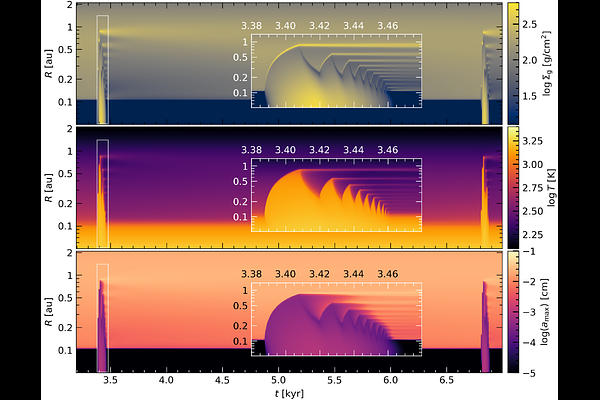
AbstractThe inner edge of the dead zone in protoplanetary disks has been shown to periodically go unstable, leading to accretion outbursts and annular substructure within the dead zone. While dust opacities play a key role in this process, the thermal and dynamical effects of dust drift and growth have not been fully explored. We investigate the evolution of accretion outbursts in the inner disk and their impact on the formation of dust-rich substructure with a fully dynamic dust model. In doing so, we aim to highlight the importance and limitations of dust growth in forming planets in this region. We carry out radiation hydrodynamics simulations of a protoplanetary disk including prescriptions for the structure of the inner edge of the dead zone, viscous and irradiation heating, radiative cooling, dust-gas dynamics, and dust evolution. We find that accretion outbursts at the inner disk edge can lead to the formation of multiple dust rings that extend deep inside the dead zone (~1 au) and diffuse on viscous timescales (~10 kyr for $α$=1e-4). The rings contain dust masses of up to ~1.6 Earth masses, possibly kickstarting planet formation. Dynamic modeling of dust fragmentation enhances the total opacity during the burst, yielding more intense outbursts that penetrate deeper into the dead zone. Our results highlight the thermal and dynamical importance of treating dust dynamics self-consistently in models of accretion outbursts. Additional modeling is needed to characterize the inevitable non-axisymmetric structures arising from accretion outbursts and their observational prospects.