Comparison of Bar Formation Mechanisms. IIIA. The role of classical bulges in spontaneous bar formation

Comparison of Bar Formation Mechanisms. IIIA. The role of classical bulges in spontaneous bar formation
Yirui Zheng, Juntai Shen, Bin-Hui Chen
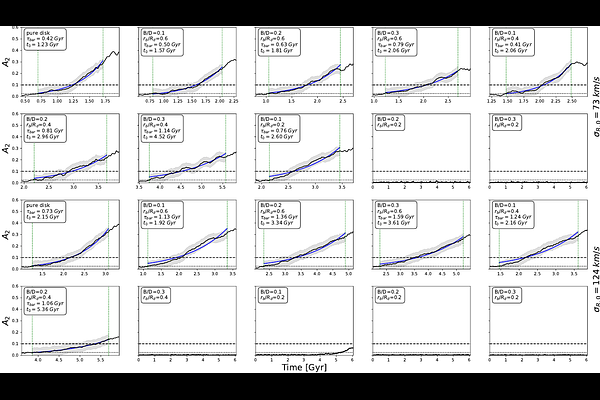
AbstractWe run a suite of $N$-body simulations to investigate how classical bulges affect bar formation and properties under the internal formation mechanism. We incorporate bulges of varying mass and compactness into disk galaxy models and evolve them in isolation to examine the resulting bar pattern speeds and growth timescales. A more massive/compact bulge increases the Toomre $Q$ stability parameter and the circular velocity in the central region, while decreasing the disk mass fraction. It therefore delays the onset of bar formation and increases the bar growth timescale; sufficiently strong bulges can suppress bar formation entirely. During the formation stage, bars exhibit higher initial pattern speeds and faster deceleration rates when the bulges become more massive or compact. This faster deceleration persists after the bar buckling phase, leading to slower-rotating bars in the secular growth stage. However, when the bulge's "diluting" effect on the measured bar strength is removed or reduced, all bars within the same disk share similar distributions in the pattern speed-bar strength ($Ω_p$-$A_2$) space during the secular growth stage. They also show comparable ratios of the co-rotation radius to the bar length ($\mathcal{R}=R_{\mathrm{CR}}/R_{\mathrm {bar}}$) in this stage. These results suggest that the bulge's influence on the pattern speed is more significant during the bar formation stage, while in the secular growth stage, the bulge's effect may be less important, and the disk component dominates the pattern speed evolution.