The ALMA Survey of Gas Evolution of PROtoplanetary Disks (AGE-PRO): Constraints on disk turbulence, fragmentation velocity, and inner pebble fluxes

The ALMA Survey of Gas Evolution of PROtoplanetary Disks (AGE-PRO): Constraints on disk turbulence, fragmentation velocity, and inner pebble fluxes
Lilian Luo, Paola Pinilla, Camila Pulgarés, Laura M. Pérez, Miguel Vioque, Nicolás T. Kurtovic, Anibal Sierra, Carolina Agurto-Gangas, Rossella Anania, John Carpenter, Lucas A. Cieza, Dingshan Deng, James Miley, Ilaria Pascucci, Giovanni P. Rosotti, Benoît Tabone, Ke Zhang
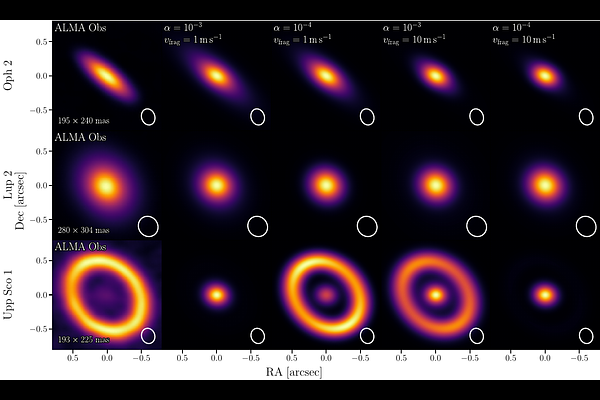
AbstractHow substructures and disk properties affect dust evolution and the delivery of solids and volatiles into planet-forming regions remains an open question. We present results from tailored dust evolution modeling of the AGE-PRO ALMA large program, a sample of 30 protoplanetary disks spanning different evolutionary stages. Visibility fitting of the AGE-PRO ALMA data (at 1.3\,mm) reveals that approximately half of the disks exhibit radial substructures. Combined with stellar properties, disk inclinations, and gas mass estimates from CO isotopologues and N$_2$H$^+$, this well-characterized set of disks provides an ideal testbed to constrain dust evolution models across different ages and disk morphologies. Using the dust evolution code \texttt{DustPy}, we simulate dust evolution in each disk under four model configurations, varying two key free parameters: the turbulent viscosity ($α= 10^{-4}, 10^{-3}$) and fragmentation velocity ($v_{\rm{frag}} = 1 \mathrm{m\,s^{-1}}, 10 \mathrm{m\,s^{-1}}$). Pressure traps are incorporated by perturbing the gas surface density based on the continuum intensity profiles, and synthetic observations generated with \texttt{RADMC-3D} are compared to these profiles. While no single model fits all disks, nearly half are best reproduced by the configuration with low turbulence and low fragmentation velocity ($α= 10^{-4}, v_{\rm{frag}} = 1\,\mathrm{m\,s^{-1}}$). Models of smooth disks underpredict dust mass, possibly indicating unresolved substructures. Pebble fluxes into inner disk regions correlate more strongly with disk age than with the presence of substructures, highlighting time-dependent dust transport as a key factor in shaping inner disk composition. Our results also provide a comparative baseline for interpreting multiwavelength and JWST water vapor observations.