PhysFormer: A Physics-Embedded Generative Model for Physically Self-Consistent Spectral Synthesis

PhysFormer: A Physics-Embedded Generative Model for Physically Self-Consistent Spectral Synthesis
Siqi Wang, Mengmeng Zhang, Yude Bu, Chaozhou Mou
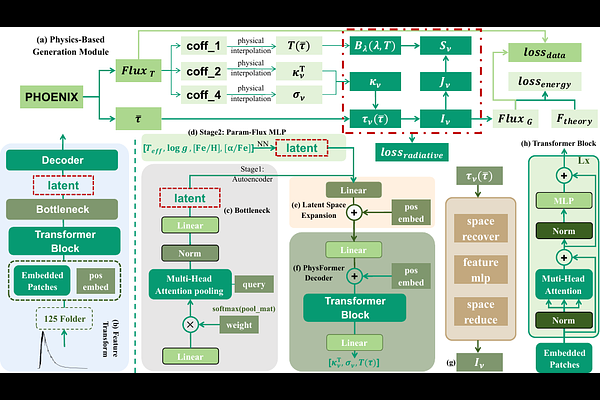
AbstractIn scientific and engineering domains, modeling high-dimensional complex systems governed by partial differential equations (PDEs) remains challenging in terms of physical consistency and numerical stability. However, existing approaches, such as physics-informed neural networks (PINNs), typically rely on known physical fields or coefficients and enforce physical constraints via external loss functions, which can lead to training instability and make it difficult to handle high-dimensional or unobservable scenarios. To this end, we propose PhysFormer, a generative modeling framework that is self-consistent at both the data and physical levels. PhysFormer leverages a low-dimensional, physically interpretable latent space to learn key physical quantities directly from data without requiring known high-dimensional physical field parameters, and embeds the physical process of radiative flux generation within the network to ensure the physical consistency of the generated spectra. In high-dimensional, degenerate inversion tasks, PhysFormer constrains generation within physical limits and enhances spectral fidelity and inversion stability under varying signal-to-noise ratios (SNRs). More broadly, this approach shifts the physical processes from external loss functions into the generative mechanism itself, providing a physically consistent generative modeling paradigm for complex systems involving unknown or unobservable physical quantities.