Catching Disguised Transients with ASTRANet: Anomaly-Aware Spectroscopic Classification and Conformal Calibration

Catching Disguised Transients with ASTRANet: Anomaly-Aware Spectroscopic Classification and Conformal Calibration
Argyro Sasli, Maojie Xu, Alexandra Junell, Hailey Markoff, Avyukt Raghuvanshi, Felipe F. Nunes, Theophile Jegou Du Laz, Jesper Sollerman, Christoffer Fremling, Drew Oldag, Antoine Le Calloch, Sushant Sharma Chaudhary, Sneha Maharjan, Maxine West, Benny Border, Nabeel Rehemtulla, Richard Dekany, Joahan Castaneda Jaimes, Russ R. Laher, Reed Riddle, Mansi M. Kasliwal, Matthew J. Graham, Ashish A. Mahabal, Michael W. Coughlin
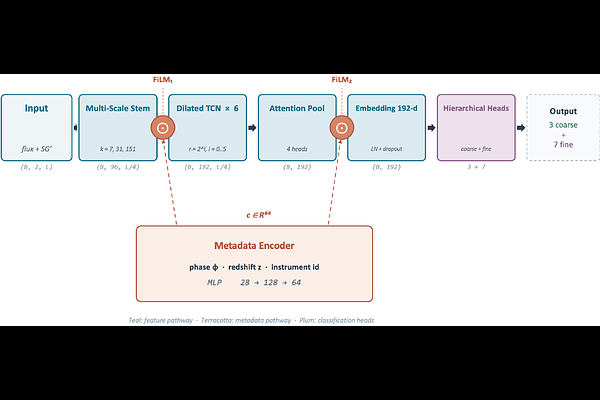
AbstractTime-domain surveys discover thousands of transients per year, but the spectroscopic identification of rare and physically peculiar objects remains rate-limited by closed-set classifiers that confidently assign every input to a known class -- including spectra that genuinely belong to no known class. We present the \texttt{ASTRANet} framework, a confidence-aware infrastructure for spectroscopic transient classification built around three coupled modules: a hierarchical spectral classifier that operates directly on observer-frame spectra without requiring host-galaxy redshift or spectral phase as inputs; an anomaly detection layer (\texttt{ASTRANet-Sentinel}) that non-linearly combines $16$ embedding-space anomaly scores spanning four physically motivated families; and a conformal uncertainty quantification layer (\texttt{ASTRANet-CP}). We validate the framework on a held-out evaluation set of $289$ rare and out-of-taxonomy transients spanning $11$ classes deliberately excluded from training, chosen to span the full physical diversity of the rare-anomaly population: AGN-related outliers, GRB-related events, gap transients, novae, and peculiar supernovae. Through five astrophysically distinct failure modes of closed-set classifiers, we show that classifier-internal uncertainty and embedding-based anomaly detection are structurally complementary axes of confidence rather than alternative implementations of the same estimator. We further introduce AD-stratified Mondrian conformal prediction (AD-MCP) within \texttt{ASTRANet-CP}, achieving uniform conditional coverage across anomaly-score strata where vanilla Mondrian under-covers in the operational regime. This establishes the methodological infrastructure for confidence-aware spectroscopic discovery in the Vera C.\ Rubin Observatory era.