Evolution of the early-type fraction in massive galaxies at $z<2$: how did early-type morphology form?

Evolution of the early-type fraction in massive galaxies at $z<2$: how did early-type morphology form?
Masaru Kajisawa
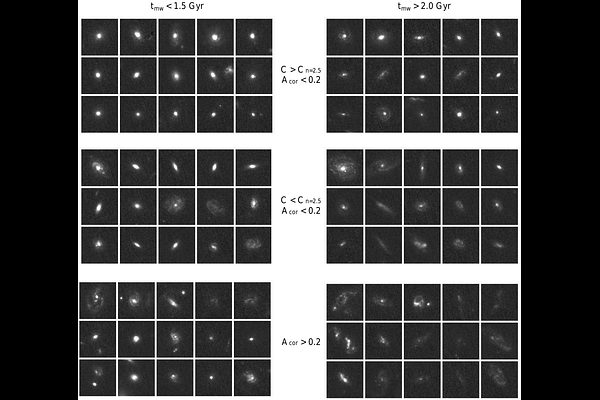
AbstractUsing $JWST$/NIRCam data over a 0.28 deg$^{2}$ area from COSMOS-Web survey, together with $HST$/ACS data, we investigate early-type fraction of massive galaxies with $M_{star}>10^{10.5}M_{\odot}$ at $0.2<z<2.0$, and explore the formation of their early-type morphology. We measure concentration index $C$ ($=R_{80}/R_{20}$) and asymmetry index $A$, and select early-type galaxies with $C>C_{n=2.5}$ and $A_{cor}<0.2$. Here $C_{n=2.5}$ is the concentration expected for a Sersic profile with $n=2.5$ under the spatial resolution and depth of the data, and $A_{cor}$ is the asymmetry corrected for resolution effects. The fraction of early-type galaxies with $M_{star}>10^{11}M_{\odot}$ ($=10^{10.5}$-$10^{11}M_{\odot}$) decreases with increasing redshift from ~70% (~40-60%) at $z$ ~ 0.3 to ~20-25% (~15-25%) at $z$ ~ 1.8. We also examine the evolution of their $R_{20}$ and $R_{80}$, which enclose 20% and 80% of the total flux of the galaxy, respectively. The median $R_{80}$ shows strong mass dependence and significant redshift evolution, whereas the median $R_{20}$ shows little dependence on either stellar mass or redshift. In contrast, morphological differences are more pronounced in $R_{20}$ than in $R_{80}$: the median $R_{20}$ of early-type galaxies is smaller than that of late-type and irregular galaxies by 0.25-0.45 and 0.3-0.6 dex, respectively. The median SSFR of sample galaxies strongly correlates with $R_{20}$, and early-type galaxies have lower SSFRs by ~1 dex. We further find that early-type galaxies at $z>1.3$ have younger mass-weighted stellar ages of $t_{mw}<2$ Gyr than late-type and irregular ones. Their SSFRs, $t_{mw}$, and morphological properties suggest that these high-$z$ early-type galaxies experienced rapid formation of a dense stellar core through starburst, followed by quenching of star formation, and subsequently resumed star formation ~1-2 Gyr later.