Cosmic voids as a probe of the nature of dark matter: simulations and galaxy survey forecasts

Cosmic voids as a probe of the nature of dark matter: simulations and galaxy survey forecasts
Alexander Spencer London, Keir K. Rogers, Alex Laguë, Renée Hložek, Zara Zaman
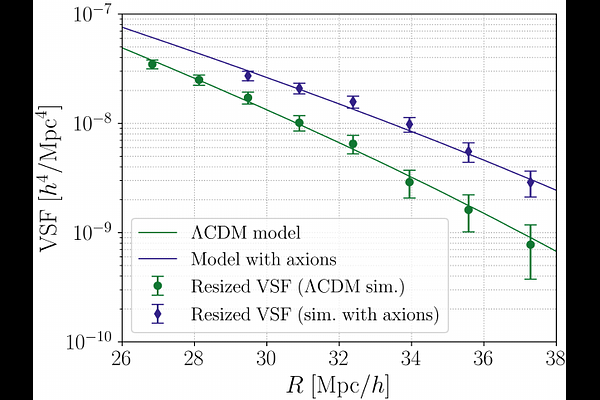
AbstractVoids are parts of the cosmic web least affected by non-linearities and baryonic feedback. We thus calculate the sensitivity of voids to the nature of dark matter (DM), using ultra-light axions as a concrete model and the ongoing Dark Energy Spectroscopic Instrument (DESI) and \textit{Euclid} galaxy surveys as observational settings. We simulate axion effects on voids using mass-peak patch simulations and find that: (i) axions suppress the formation of lower-mass halos leading to the merging of smaller (radius $< 25\,\mathrm{Mpc}/h$) voids into fewer larger (radius $> 25\,\mathrm{Mpc}/h$) voids; and (ii) voids in the presence of axions are emptier of halos, thereby suppressing the void-halo correlation function. These effects strengthen as axion particle mass $m_\mathrm{a}$ decreases. We forecast improvements in axion constraints from the void size function (VSF; the void number density as function of their radius). A \textit{Euclid}-like survey (effective volume of $73\,\mathrm{Gpc}^3$ with a prior on the other $Λ$CDM cosmological parameters from the Simons Observatory cosmic microwave background experiment) can limit the axion energy density (for $m_\mathrm{a} = 10^{-25}\,\mathrm{eV}$) to $< 4.6\%$ of the DM (at $95\%$ credibility), about two times stronger than current limits. Conversely, we show that a Universe with a dark sector consisting of axions at the $10\%$ level, as motivated by the string axiverse, can be recovered with $\sim 2 σ$ preference. A DESI-like survey achieves comparable results. Axion and $Λ$CDM parameters have different degeneracies given VSF and galaxy power spectrum data, indicating future combined analyses will be most powerful in disentangling the DM nature. We anticipate our results will extend to other (e.g., warm or interacting) DM models.