Planetary Habitable Zones around Magnetized White Dwarfs

Planetary Habitable Zones around Magnetized White Dwarfs
Xueyuan Wang, Cong Yu, Bo Ma, Di-Chang Chen, Jianheng Guo
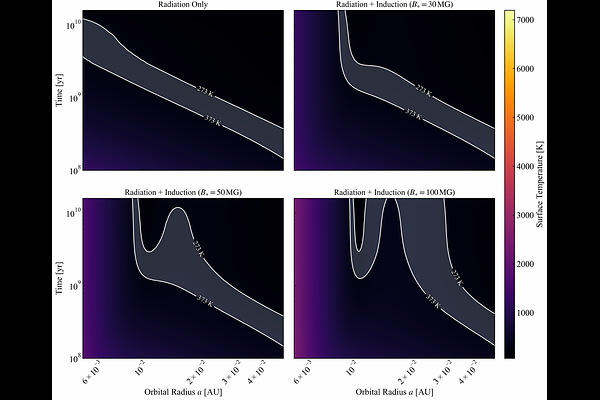
AbstractWhite dwarfs are known to host remnant planetary material, indicating that rocky objects can survive post-main-sequence evolution and migrate into very close orbits. However, the decline of white dwarf luminosity makes it difficult for a planet to remain habitable for long when relying only on the white dwarf's irradiative heating. While several non-radiative energy sources have been proposed, the role of white dwarf magnetism in planetary energy budgets remains largely unexplored. We examine whether magnetic unipolar induction could provide sustained heating for close-in rocky planets. By coupling white dwarf cooling tracks with an orbit-dependent induction model, we evaluate the contribution of ohmic dissipation to planetary surface energy budgets and estimate the upper limit with efficient heat deposition. It is possible for the induction heating to supply a nearly steady surface energy flux for certain orbital distances and stellar spins, partially offsetting the decline in the white dwarf irradiation at late times. This leads to a persistent outer temperate region and, in some cases, a narrow inner zone that emerges after substantial cooling, identifying magnetic induction as a viable long-lived supplement to radiative heating.