PCGD: Physics-Guided Conditional Graph Diffusion for TCAD Device Simulation

PCGD: Physics-Guided Conditional Graph Diffusion for TCAD Device Simulation
Yihan Zhang, Zhiteng Zhang, Kun Chen, Chen Wang
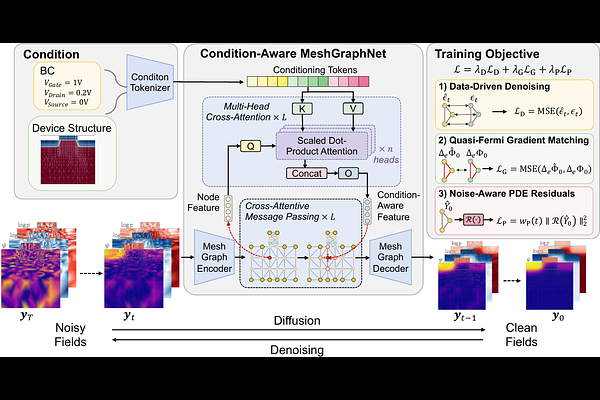
AbstractTechnology computer-aided design (TCAD) semiconductor device simulation is fundamentally constrained by the high computational cost of iteratively solving coupled drift-diffusion equations. Existing ML surrogates either reduce internal physics to macroscopic scalar regressions, or rely on single-step mappings that lack the iterative refinement required to resolve stiff, coupled fields. To address this, we introduce PCGD, a Physics-Guided Conditional Graph Diffusion framework operating natively on unstructured TCAD meshes to predict coupled electrostatic and carrier density fields. PCGD employs a Condition-Aware MeshGraphNet denoiser that explicitly injects boundary conditions and device structure context via global cross-attention. By augmenting data-driven denoising with a physics-guided hybrid objective that integrates exponent-free quasi-Fermi gradient matching with noise-aware PDE residuals, PCGD progressively enforce physical constraints in the iterative diffusion trajectory. This strategy successfully bypasses the numerical instabilities typical of stiff drift-diffusion equations. Evaluated on a challenging mixed PN/MOS benchmark, PCGD significantly outperforms deterministic one-step regression (1.207% error) and local diffusion (1.585% error) baselines by achieving a sub-percent mean relative field error of 0.835%, while concurrently reducing maximum PDE residual errors by nearly three orders of magnitude compared to pure diffusion. It also transfers robustly to unseen SOI topologies (0.815% error) via LoRA adaptation, using 5.30$\times$ less data and 14.34$\times$ fewer parameters than full fine-tuning. Ultimately, PCGD bridges the computational efficiency of generative surrogates with the rigorous physical fidelity of traditional TCAD, unlocking highly scalable, field-level analysis for robust device engineering.