Quasi-Periodic Polarized Emissions from Kink Structure in Magnetized Relativistic Jets

Quasi-Periodic Polarized Emissions from Kink Structure in Magnetized Relativistic Jets
Xu-Fan Hu, Hong-Xuan Jiang, Yosuke Mizuno, Christian M. Fromm, Bhargav Vaidya
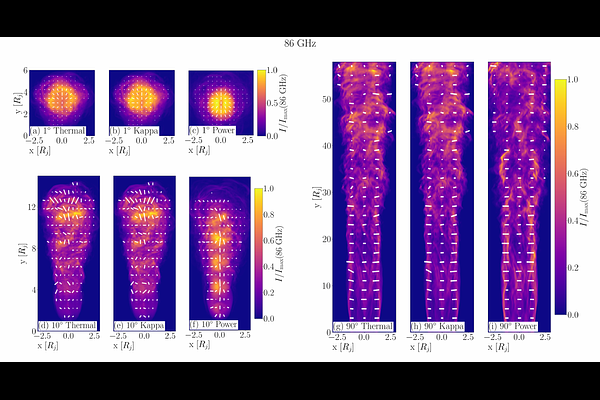
AbstractRecent polarimetric observations of blazars indicate the development of current-driven (CD) kink instability after passing the recollimation shocks in the relativistic jets and association with quasi-periodic oscillations (QPOs). To investigate multi-wavelength polarized features of CD kink instability in jets, we develop {\tt RaptorP}, a new special relativistic module of the polarized General Relativistic Radiative Transfer (GRRT) code {\tt RAPTOR}. Based on 3D SRMHD simulations of over-pressured magnetized jets, we find that jet images vary at different frequencies. At low frequencies, the emission comes from the turbulent ambient medium surrounding the jet that obscures the inner jet structure. Electronic Vector Position Angle (EVPA) patterns are perpendicular to the jet propagation direction, indicating a dominance of the poloidal magnetic field. At high frequencies, bright knots and twisted kink structures appear, and EVPA patterns are consistent with a toroidal magnetic field. We also find that QPOs in light curves of intensity and linear polarization (degree and angle). The peak frequency in Power Spectral Densities (PSDs) is well-matched with the rotation period of the kink structure in relativistic jets. It shows an anti-correlation between total intensity and the degree of polarization at a lower inclination angle. Our findings, based on realistic polarized radiation calculations, will explain the observational signatures seen in blazars.