The extremely low-luminosity Type Iax SNe 2022ywf and 2023zgx

The extremely low-luminosity Type Iax SNe 2022ywf and 2023zgx
Barnabás Barna, Dominik Bánhidi, Tamás Szalai, Joseph P. Anderson, Teresa Boland, K. Azalee Bostroem, Ting-Wan Chen, Joseph Farah, Mariusz Gromadzki, Griffin Hosseinzadeh, D. Andrew Howell, Cosimo Inserra, Saurabh W. Jha, Lindsey A. Kwok, Colin Macrie, Curtis McCully, Erika Mochnács, Tomás E. Müller-Bravo, Megan Newsome, Estefania Padilla Gonzalez, Jeniveve Pearson, Tanja Petrushevska, David J. Sand, Manisha Shrestha, Nathan Smith, Shubham Srivastav, Giacomo Terreran, József Vinkó
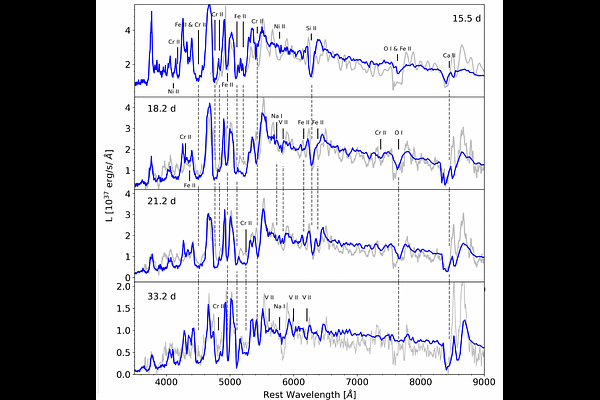
AbstractWe present the optical follow-up of SNe 2022ywf and 2023zgx, two examples from the Iax subclass of thermonuclear supernova (SN) events. With peak absolute magnitudes of $M_\mathrm{V} = -13.7$ and $-14.4$ mag, respectively, both objects belong to the extremely low-luminosity (EL) population of the class. A common origin of SNe in the Iax subclass is still under debate since the distribution of certain observables may indicate that the extremely low-luminosity explosions form a distinct population. We aim to estimate the physical properties of the two EL objects, including mapping the ejecta structure. We perform spectral tomography on the spectral series of SNe 2022ywf and 2023zgx around their maxima to map the physical properties of the ejecta. Together with the analysis of BgVriz photometry, a wide range of observables can be studied to investigate their distribution against luminosity. The constrained chemical abundances of the ejecta are compared to the predictions of the hydrodynamic simulations with similar peak luminosities. Constant abundances provide a good match for the distribution of chemical elements for both SNe 2022ywf and 2023zgx. The discrepancies compared to the least luminous pure deflagration model N5def_hybrid are minor, especially at post-maximum epochs. The two SNe also share similar characteristics in their constrained density structures, as well as the evolution of the photosphere. The analysis supports the assumption that pure deflagration models can reproduce the main characteristics of SNe Iax, even for the EL population. The presented indirect observational evidence indicates that these objects show similar intrinsic properties to the relatively luminous Iax sample and fit into the velocity distribution of the subclass.