Tracing the kinematic perturbations of the Milky Way spiral arms with APOGEE DR17 and Gaia DR3

Tracing the kinematic perturbations of the Milky Way spiral arms with APOGEE DR17 and Gaia DR3
Xi-Can Tang, Zhi Li, Iulia T. Simion, Hao Tian, Zhijian Luo, Shuting Fan, Zi-Qi Li
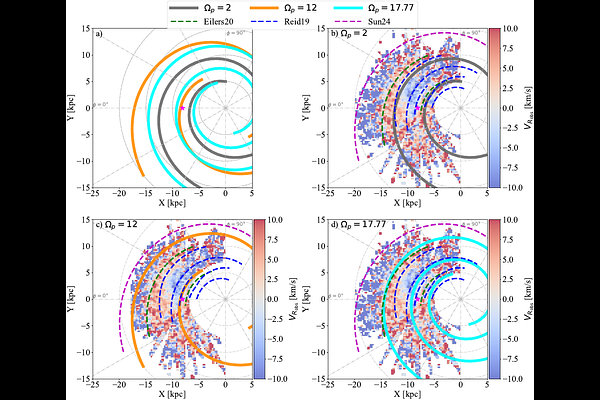
AbstractAims. We constrain the dynamical perturbations of the spiral arms in the Milky Way disk, based on the non-axisymmetric streaming motions of RGB stars revealed by APOGEE and \textit{Gaia}. Methods. We develop a revised steady-state radial-velocity response model that incorporates both the \(V_{R,\sin}\) and the dynamically important \(V_{R,\cos}\) components for a two-armed logarithmic spiral potential. The model is validated using orbit integrations with \texttt{AGAMA} and Bayesian parameter recovery with \texttt{dynesty}, and is applied to the smoothed two-dimensional radial-velocity field of RGB stars while accounting for Lindblad and corotation resonances. Results. The revised model reproduces the phase and amplitude of the mock radial-velocity field to the \(\sim2\%\) level, substantially improving upon earlier \(V_{R,\sin}\)-only formulations. Applied to the observational data, it yields a robust pitch angle of \(p \simeq 10^\circ\) and a local surface density contrast of \(ξ\simeq 5\)--\(18\%\) at the solar radius. The radial scale length is less well-constrained (\(h_{R,1} \simeq 40\)--\(50\,\mathrm{kpc}\)) due to intrinsic parameter covariance. Resonance effects strongly shape the velocity field, thus affecting the fitting: the radial velocity becomes extremely large near the Lindblad resonances, whereas it vanishes close to the corotation resonance. Conclusions. Our results demonstrate that including both the \(V_{R,\sin}\) and \(V_{R,\cos}\) terms is essential for a physically consistent interpretation of stellar streaming motions induced by a spiral potential. The observed kinematics constrain the spiral pattern speed to \(Ω_{p} \approx 10\)--\(20\,\mathrm{km\,s}^{-1}\mathrm{kpc}^{-1}\).