Evidence for the transition from thermal to non-thermal emission in the prompt emission of GRB 161117A

Evidence for the transition from thermal to non-thermal emission in the prompt emission of GRB 161117A
Xue-Zhao Chang, HouJun Lü, Jia-Ming Chen, En-Wei Liang
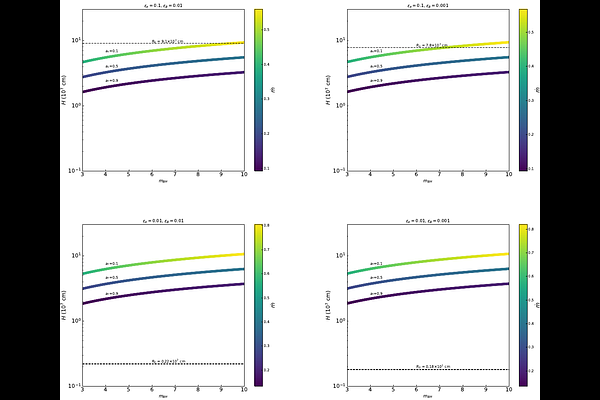
AbstractGRB 161117A is a long-duration GRB with three main overlapping peaks. By analyzing the time-resolved spectra of its data observed with the Gamma-Ray Burst Monitor (GBM) on board the Fermi mission, we find that the spectral evolution shows a transition from thermal (single BB) to hybrid (PL$+$BB), and finally to non-thermal (Band and CPL) emissions. Such a transition suggests that the jet composition of GRB 161117A should be changed from a fireball to a Poynting-flux-dominated jet. The bulk Lorentz factor ($Γ_{\rm ph}$), radii ($R_{\rm ph}$ and $R_{0}$), magnetization factor at the central engine ($σ_0$), and dimensionless entropy ($η$) of the outflow can be inferred by invoking the observed quasi-thermal component within two models (e.g., pure fireball and hybrid). It is found that $Γ_{\rm ph}$ seems to be tracking with the light curve, and $R_{0}$ remains a constant at $\sim$ $10^{8}$ cm. The low magnetization ($1+σ_0 \sim$ 1) and high dimensionless entropy ($η\gg$ 1) during the first seven time-intervals suggest to be a pure fireball outflow. Moreover, we also estimate the lower limit of magnetization parameter at the photosphere radius ($σ_{\rm ph}\sim 1.4$ and 0.75) for late phase via the non-thermal spectra, and it indicates that the particle acceleration mechanism is dominated by internal shocks rather than magnetic dissipation processes. Finally, the $ν\barν$ annihilation mechanism of NDAF model to explain the thermal emission of GRB 161117A is also discussed.