TEQUILA: Mechanism-free polarimetry for astronomy

TEQUILA: Mechanism-free polarimetry for astronomy
Alan M. Watson, Noémie Globus
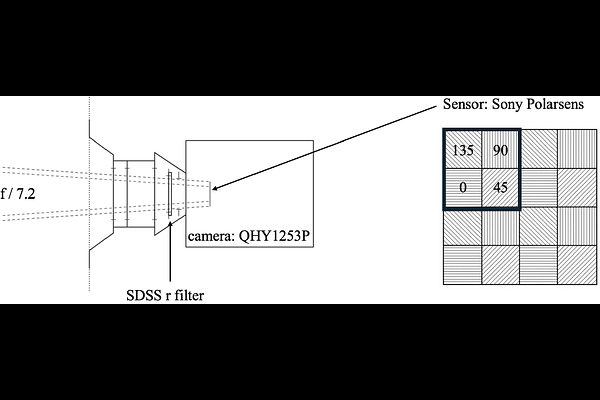
AbstractTEQUILA (Transient Event $Q$, $U$, and $I$ Light Analyzer) is an optical imaging polarimeter developed for the second Nasmyth port of the 1.3-m COLIBRÍ altitude-azimuth telescope at Observatorio Astronómico Nacional in San Pedro Mártir, México (OAN-SPM). TEQUILA uses a CMOS sensor with an on-chip wire-grid micro-polarizer array to obtain simultaneous, single-exposure measurements of the Stokes parameters $I$, $Q$, and $U$ without moving optical components. This mechanism-free instrument, built entirely from commercial components, delivers seeing-limited imaging in a fixed optical band and is optimized for early-time follow-up of transient sources, including gamma-ray burst afterglows, blazars, and variable young stellar objects. In this paper, we describe the scientific motivation, the instrument design and implementation, the calibration, and initial science results. Sensor characterization reveals a polarimetric structure in the flat field and a low quantum efficiency, which we estimate to be approximately 17%, including losses introduced by the micro-polarizer array. For point sources, TEQUILA achieves absolute polarimetry with RMS uncertainties of 0.15% in pupil-tracking observations and 0.20% in field-tracking observations. In pupil-tracking mode, the observed RMS is fully explained by the measurement and standard-star uncertainties, with no evidence for an additional calibration term. In contrast, field-tracking observations require an additional calibration uncertainty of approximately 0.10%. Calibration for resolved-source polarimetry remains in progress.